The Winter Barrier: Mitigating Snow Accumulation Yield Losses

When calculating the annual performance of utility-scale solar assets, operators often look to the high-generation summer months to secure their baseline revenue. However, for portfolios located in high-latitude or mountainous cold regions, the true test of operational profitability happens in the dead of winter.
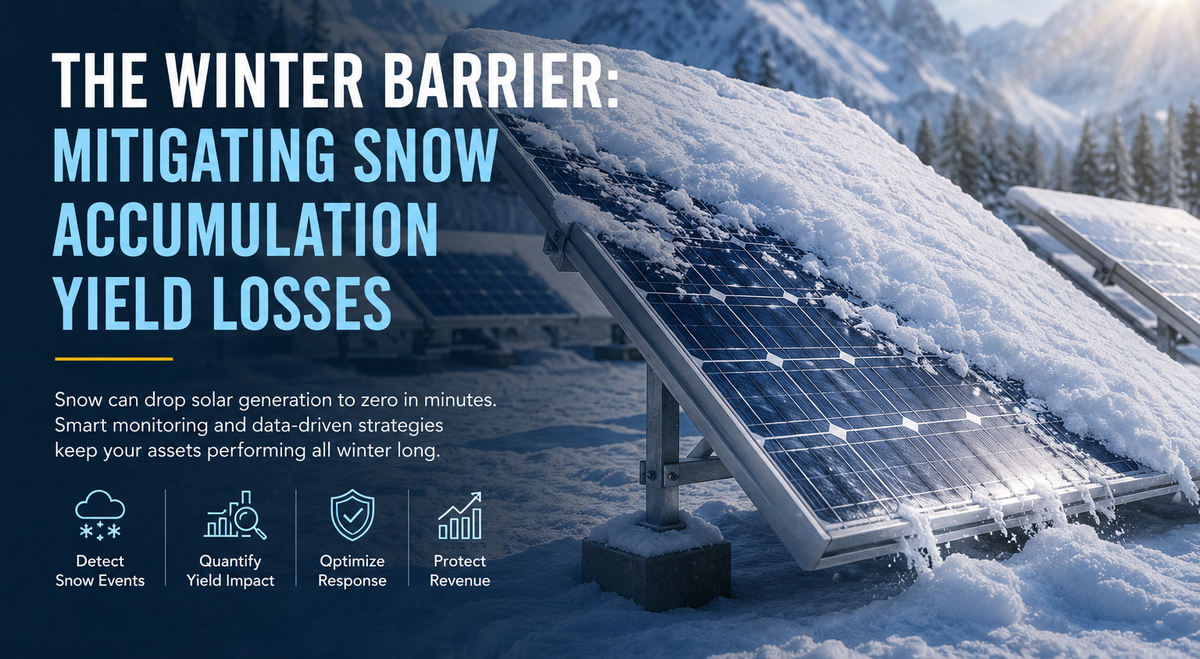
Snow accumulation yield losses represent a Medium Severity environmental threat that can severely compromise a plant's performance metrics. Unlike fine mineral dust, snow doesn't just reduce light transmittance; it can act as an absolute blanket, dropping string generation down to zero in a matter of minutes. At HelioExpect, we believe that mastering cold-climate asset management requires moving past simple guesswork and embracing advanced, weather-driven analytics.
The Dynamic Impact Factor of Snow Cover
Snow losses do not behave like standard soiling. The lifecycle of a snow event introduces distinct, escalating phases of power degradation across a photovoltaic array:
- Complete Irradiance Blockage: A fresh snowfall layer of just 2 to 3 centimeters is thick enough to block nearly all incoming global horizontal irradiance (GHI) from reaching the solar cells. Until this layer clears, the affected modules remain completely offline.
- Partial-String Mismatch During Melting: As ambient temperatures rise or the sun begins to emerge, snow does not clear uniformly. It melts, sheds, and slides down the module face. This creates a state of severe partial-string mismatch. Because cells are wired in series, a heavy bank of snow remaining at the bottom frame of a tilted panel can choke out the output of the entire unshaded top section.
- Compounded Winter Energy Deficits: In regions with prolonged sub-zero temperatures, snow can remain frozen on arrays for weeks. This creates a persistent energy loss that heavily penalizes winter capacity utilization factors (CUF) and skews baseline financial expectations if not properly accounted for.
Detection Method: Dissecting the Cold-Climate Data
Because a snow-covered array produces zero power, standard SCADA systems can easily mistake a snow event for an inverter outage, a tracker failure, or a grid disconnection. To prevent operations and maintenance (O&M) teams from hunting down false hardware alerts, a sophisticated, multi-point detection workflow is required.
An intelligent asset management platform isolates snow-driven losses by cross-referencing six essential data points:
- Production Residual Tracking: Measuring the exact delta between your predictive clear-sky power model and real-time actual output.
- Local Meteorological Data: Integrating real-time snowfall metrics and ambient snow depth data into the analytics pipeline.
- Plane-of-Array (POA) Irradiance vs. Output: Monitoring when POA pyranometers register high available light, yet the array current remains flatlined, indicating a physical blockage on the module glass.
- Module Temperature Anomalies: Tracking when module temperatures match ambient freezing levels, confirming the absence of internal electrical current flow (which would naturally warm the cells).
- On-Site Sky Cameras: Utilizing automated optical or thermal camera observations to visually verify snow persistence across distinct sections of the array.
- Regional Snow-Loss Model Outputs: Validating real-world performance dips against historical, regional snow-loss coefficients to confirm behavior matches localized climate baselines.
Mitigation: Data-Driven Strategies for Cold Climates
You cannot stop the snow from falling, but you can dramatically optimize how your solar asset portfolio adapts, sheds, and recovers from winter weather events.
1. Separate Winter Residuals from Generic Soiling
The most common mistake in solar asset management is grouping all environmental losses under a single "soiling" umbrella. Snow behaves entirely differently from dust or agricultural residue. Operators must track winter residuals as a distinct, isolated metric. This keeps your spring and summer soiling accumulation curves clean and ensures your operational datasets remain highly accurate.
2. Leverage Validated Snow-Loss Assumptions in the Energy Model
Pre-construction P50/P90 yield models frequently underestimate real-world snow-shedding timelines. Asset owners should continuously update and calibrate their post-construction energy models using validated, empirical snow-loss assumptions. This creates an honest, bankable baseline that protects your financial forecasting from unexpected winter deficits.
3. Implement Advanced Tracker Stow and Tilt Strategies
For sites utilizing single-axis trackers, hardware logic can be used defensively. When heavy snow is forecasted, operators can initiate a proactive tracker stow strategy, moving the modules to an aggressive, near-vertical tilt angle (e.g., 50° to 60°). This prevents snow from piling up heavily on the glass and allows gravity to accelerate the slide-off process as soon as the storm clears.
4. Evaluate the Economics of Active Intervention
While manual snow removal or mechanical shedding tools exist, they carry high operational expenses (OPEX) and risk scratching the module’s anti-reflective coating (ARC). Before deploying field crews, run an automated cost-benefit analysis. Compare the precise financial value of the projected lost energy against the contractual cost of a physical maintenance mobilization to determine if active intervention is truly economic.
Achieve Winter Resilience with HelioExpect
Snow accumulation is an unavoidable reality for northern solar infrastructure, but unexpected underperformance is not. At HelioExpect, we combine high-resolution solar forecasting, predictive weather integration, and deep telemetry analysis to help developers and asset managers see clearly through the winter freeze.
By isolating environmental variables and accurately predicting shedding timelines, we provide the actionable intelligence needed to eliminate systemic losses and protect the long-term ROI of your clean energy portfolios.