Democratizing the Indian Sun: Why Shared Solar is the Unlocking Mechanism for India’s Clean Energy Future

India stands at a pivotal junction in its national energy trajectory. The nation’s commitment to expanding non-fossil fuel electricity infrastructure has materialized at an unprecedented pace. Cumulative installed renewable energy capacity surpassed 274 gigawatts, with total solar capacity climbing past 164 gigawatts. Behind these macro-level achievements lies a deep structural imbalance that threatens to leave millions of energy consumers behind.
While utility-scale solar farms across the desert expanses of Rajasthan and Gujarat drive the bulk of capacity, distributed solar adoption remains tightly bottlenecked. Individual rooftop solar technology operates under a fundamental constraint: it requires property ownership, financial liquidity, and physical roof integrity. In a nation defined by rapid urban density, multi-tenant residential complexes, fragmented commercial properties, and low-income rural settlements, traditional rooftop solar cannot achieve total energy democratization.
Shared solar, often designated globally as community solar offers a structural bypass to these physical and institutional barriers. By allowing multiple power consumers to purchase, lease, or subscribe to a share of an off-site or centralized solar array and receive direct electricity bill credits, shared solar transforms clean energy from a privilege of private landowners into a public utility asset. Unlocking this model is essential for India to reach its long-term decarbonization goals, build climate resilience, and lower total energy expenditure for millions of households and small enterprises.
1. The Distributed Solar Paradox: Macro Targets versus Structural Access
To understand the imperative for shared solar, one must examine the operational state of solar installations in India. Utility-scale solar projects - vast, multi-megawatt ground-mounted installations—account for roughly 122.57 gigawatts of national solar capacity. In contrast, grid-connected rooftop solar accounts for approximately 30.74 gigawatts.
The central government has deployed aggressive policy frameworks to address this disparity. Schemes such as PM Surya Ghar: Muft Bijli Yojana have catalyzed residential adoption, driving millions of household registrations and deploying capital subsidies. Yet, even as rooftop solar adoption speeds up under heavy fiscal interventions, a structural ceiling persists.
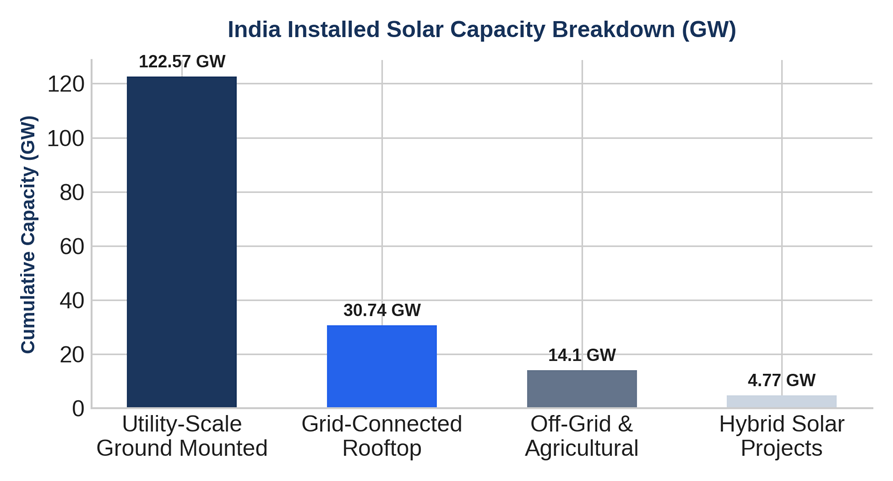
Figure 1: Breakdown of India's Total Installed Solar Capacity Portfolio (GW)
The Council on Energy, Environment and Water (CEEW) estimates that India’s technical rooftop solar potential stands at an astonishing 637 gigawatts. Yet, the physical reality of Indian housing stock prevents more than eighty percent of urban residents from accessing direct rooftop installations. Multi-story apartment buildings, where roof area is common property managed by Resident Welfare Associations (RWAs), create governance deadlocks regarding who owns the space, who funds the installation, and how generated units are credited. Commercial tenants, operating out of leased retail facilities or office parks, are legally barred from modifying building roofs. Low-income urban households reside in structures that lack the load-bearing capacity required to support heavy photovoltaic arrays.
2. The Regulatory Framework: Virtual Net Metering as the Enabler
The execution of shared solar relies entirely on an administrative mechanism known as Virtual Net Metering (VNM). Under standard net metering, a bi-directional meter measures energy exported to and imported from a solar array mounted directly on the consumer's premises. The electricity distribution company (DISCOM) offsets the consumer's monthly consumption against their on-site generation, billing only the net difference.
Virtual Net Metering expands this accounting mechanism across multiple geographic locations. Under a VNM arrangement, an off-site solar system generates electricity and feeds it directly into the DISCOM’s medium-voltage distribution grid. The DISCOM tracks total generation and distributes pro-rata bill credits to the account ledgers of participating subscribers based on their contractual ownership share or subscription tier.
Regulatory Fragmentation and DISCOM Friction
The regulatory adoption of Virtual Net Metering across Indian states remains fragmented. Early adopters like the Delhi Electricity Regulatory Commission (DERC) introduced VNM provisions specifically targeting group housing societies, educational institutions, and government facilities. The Ministry of Power's Electricity (Rights of Consumers) Rules provided further policy direction toward consumer choice and distributed renewable access.
Broad national adoption faces systemic friction from state-level DISCOMs. Electricity distribution companies in India operate under severe financial stress, burdened by legacy debts, high aggregate technical and commercial (AT&C) losses, and cross-subsidization structures. In the standard Indian tariff architecture, industrial and commercial consumers pay inflated electricity rates to subsidize agricultural and low-income residential users. DISCOMs fear that shared solar will enable high-paying commercial clients to pool resources, build off-site solar arrays, and use Virtual Net Metering to escape higher tariffs, eroding the utility’s revenue base.
3. Economic and Socio-Environmental Impact Dynamics
The financial incentives driving shared solar extend across multiple stakeholder layers, creating economic value that standard utility scale projects cannot deliver due to distant location constraints and transmission losses.
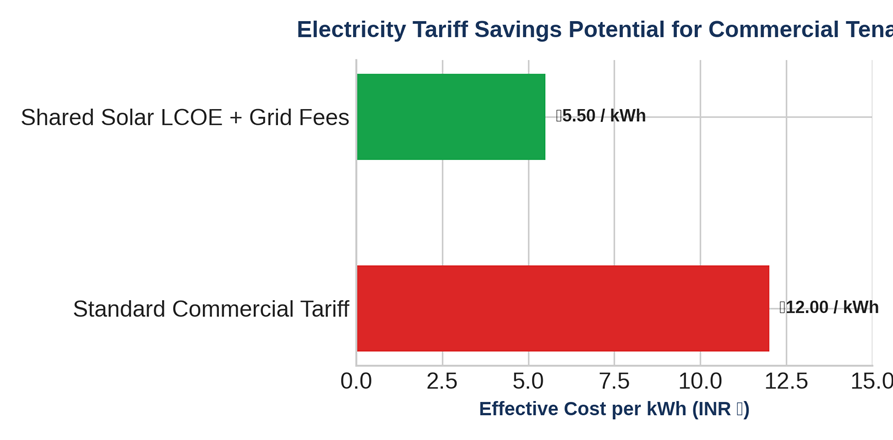
Figure 2: Cost Comparison between Commercial Utility Tariff and Shared Solar LCOE
For urban end-users, shared solar offers immediate power cost reduction without upfront structural investment. A commercial tenant paying twelve rupees per kilowatt-hour under standard commercial utility tariffs can subscribe to a shared solar project with a levelized cost of energy ranging between four and five rupees per kilowatt-hour. After accounting for DISCOM wheeling fees and grid service charges, net power costs decline by 20% to 35% over the contract lifecycle.
For low-income and multi-family residential clusters, shared solar alters the socio-economic calculus of energy access. Instead of requiring an individual household to secure high-interest collateral loans for private panel installations, community developers pool capital from impact investors, municipal funds, or corporate social responsibility programs to construct neighborhood-scale plants. Subscribers buy small, flexible shares as low as 100 watts and receive direct relief on monthly power bills.
Utility-scale solar projects demand roughly 1.2 to 2 hectares of contiguous land per megawatt, triggering land acquisition disputes, agricultural dislocation, and ecological degradation in arid zones. Shared solar installations prioritize underutilized space: industrial warehouse roofs, urban parking structures, canal tops, contaminated brownfield sites, and municipal waste management yards. This land-neutral deployment model integrates generation directly into consumption centers.
4. Financial Architecture and Business Models
Scaling shared solar across India requires business structures adapted to diverse consumer segments and financial constraints. Three primary operational models have emerged in global markets and are being tailored for Indian conditions:
A. Utility-Led Model
The Utility-Led Model relies on state distribution utilities financing, constructing, and maintaining community solar plants. Subscribers opt into a voluntary tariff program, paying a fixed monthly subscription fee in exchange for guaranteed bill credits tied to plant output. This model provides maximum security for conservative retail consumers and leverages the utility’s existing billing infrastructure.
B. Developer-Owned / RESCO Model
The Developer-Owned or RESCO Model positions private solar energy service companies as project sponsors. The RESCO secures land or commercial roof leases, arranges project debt from institutions like the Indian Renewable Energy Development Agency (IREDA), constructs the facility, and markets subscriptions to commercial hubs, retail outlets, and residential welfare associations. The developer bears operational risk and manages subscriber churn.
C. Cooperative / Community-Owned Model
The Cooperative-Owned Model emphasizes local economic retention. Housing societies, commercial associations, or rural Panchayats pool member capital to fund an array. Participants own proportional equity in the hardware assets. All generated electricity value flows directly back to equity holders through reduced utility obligations, creating localized capital accumulation.
5. Strategic Roadmap for National Deployment
Achieving the full potential of shared solar requires a phased implementation strategy spanning policy formulation, pilot execution, and broad institutional scaling:
Shared solar represents the critical missing link in India’s renewable energy ecosystem. By removing physical and economic barriers through Virtual Net Metering, this model transforms clean power generation into an inclusive asset for urban tenants, low-income communities, and small businesses alike. Overcoming state-level DISCOM friction and harmonizing tariff structures will be vital to unlocking its full potential. Ultimately, scaling shared solar across the nation will not only accelerate India's progress toward its long-term decarbonization goals, but also build a resilient, equitable, and democratic energy future for millions of citizens.