The Structural Twist: Resolving Performance Loss from Tracker Twist

When managing utility-scale solar portfolios, operations and maintenance (O&M) teams heavily rely on automated single-axis trackers to keep modules perfectly aligned with the sun. However, as tracking rows stretch longer to accommodate high-capacity strings, a hidden mechanical vulnerability often emerges.
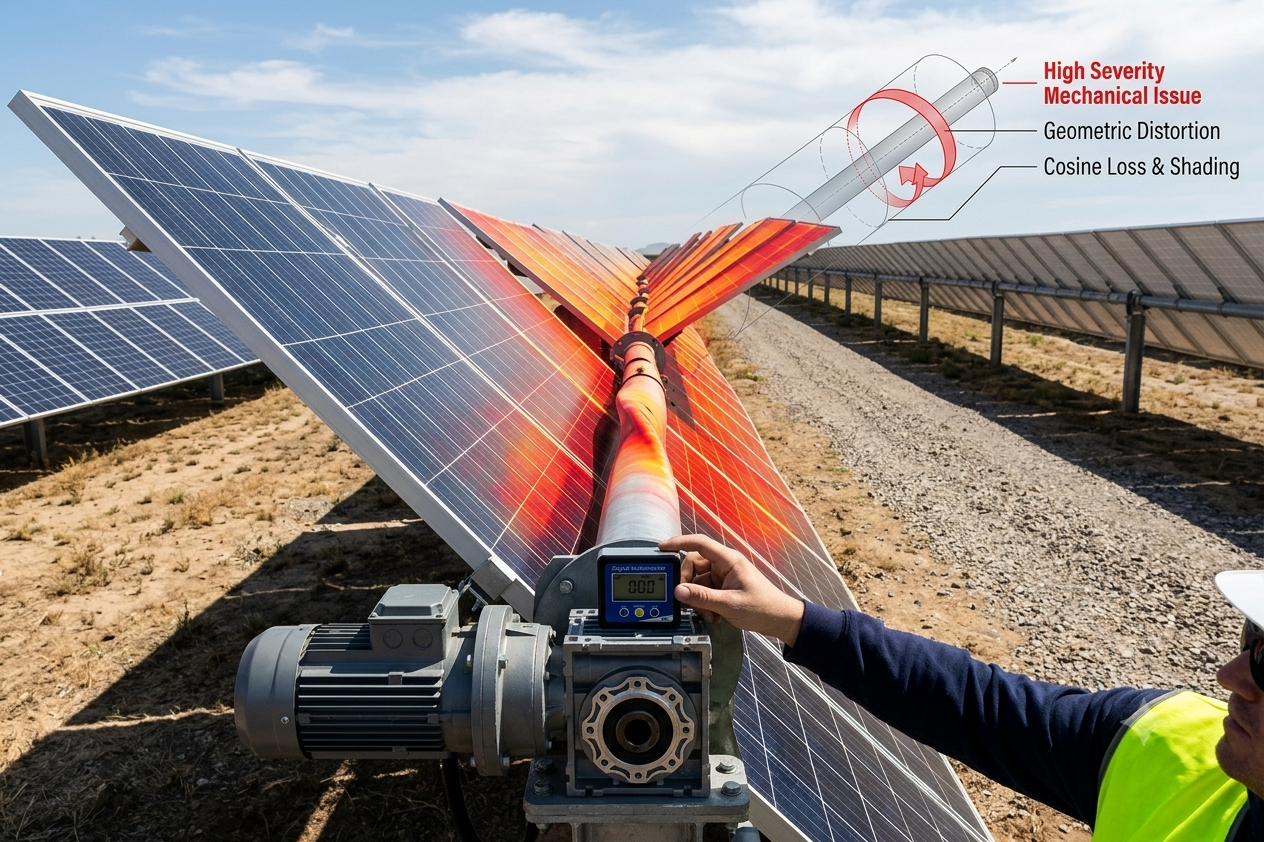
Performance loss from tracker twist represents a High Severity mechanical issue that directly undermines your plant's performance ratio (PR). This phenomenon, driven by row torsion, creates a structural warp where different sections of the exact same tracker row point in entirely different directions. Left unmanaged, tracker twist introduces severe efficiency drains and persistent electrical mismatches that can depress clean energy production across an entire tracker block.
The Physics of Torsion: How Tracker Twist Steals Power
Single-axis tracking systems rely on a central drive actuator (the motor and gearbox) to rotate a long steel torque tube, which supports the photovoltaic modules.
In a perfectly functioning system, a rotation command moves the entire row uniformly. However, because these rows can stretch over 100 meters in length, mechanical resistance, wind loading, and gravity introduce structural torsion.
[ Drive Actuator / Center ] ───> Correct Commanded Angle (e.g., 45°)
│
▼
[ Torque Tube Twists Under Structural Stress ]
│
▼
[ Far Ends of Row ] ───────────> Slack Angle (e.g., 38°) = Heavy Cosine & Shading Losses
When a system suffers from tracker twist, the center of the row near the actuator may reach its commanded angle, but the structural twist causes the far ends of the row to lag behind. This geometric distortion triggers three distinct forms of energy loss:
- Severe Cosine Loss: Because the modules at the far ends of the torque tube are misaligned with the sun's direct path, they experience a drop in effective plane-of-array (POA) irradiance.
- Row-to-Row Shading: During early morning or late afternoon backtracking windows, a twisted row breaks the geometric harmony of the array. The misaligned sections will block adjacent rows, casting unexpected, linear shadows across healthy module strings.
- Persistent Mismatch Losses: Because solar cells are wired in series, the current of an entire string is dictated by its worst-performing cell. A slight tilt variation at the end of a row chokes out the electrical current ($I_{mp}$) of the entire circuit, amplifying a localized mechanical slip into a massive block-wide yield gap.
Detection Method: Mapping Mechanical Deflection through Data
Because tracker twist is a gradual mechanical deflection, it rarely triggers standard SCADA motor fault codes. The tracker believes it has completed its movement, but the physical hardware tells a different story.
To catch this structural bottleneck before it compromises your long-term portfolio yields, asset managers must combine digital analytics with ground-level field validation:
Drone Imagery and Aerial Thermography
Deploying drones equipped with high-resolution optical and thermal sensors during peak morning or afternoon tracking sweeps is the fastest way to map structural warp. From an aerial perspective, twisted rows display a clear visual misalignment. Thermographic data will also show characteristic "step" heating profiles on strings affected by row-to-row shading.
Inclinometer Audits & SCADA Cross-Referencing
Technicians can place digital inclinometers at multiple points along a single torque tube—specifically comparing the angle directly at the drive actuator against the angles at the extreme edges of the row. This data is then cross-referenced against the SCADA system’s commanded angle telemetry to measure the exact degree of mechanical deflection.
POA Irradiance-Normalized String Output
Analyze string-level current and power output during clear-sky windows. If strings connected to the far ends of a tracker block show a distinct, asymmetrical power deficit compared to center strings when normalized against plane-of-array irradiance, tracker twist is almost certainly the root cause.
Mitigation: Straightening the Line of Generation
Correcting tracker twist requires a disciplined, step-by-step mechanical alignment and calibration protocol to restore structural integrity to the array.
1.Correct Actuator Calibration and Torque Tube Alignment:Mechanical Realignment.
Lock the tracking system into a neutral position and loosen the structural clamps along the torque tube. Manually realign the warped sections until the entire row is perfectly level from end to end, then recalibrate the drive actuator's zero-point reference setting.
2.Repair Bent or Loose Mechanical Members:Structural Reinforcement.
Inspect the row for structural wear. Tighten loose dampeners, replace worn bearings, and repair or reinforce any bent mechanical linkages or torque tube splines that are allowing the steel to flex under high wind loads.
3.Verify and Tune Backtracking Settings:Software Calibration.
Review the tracking algorithm parameters within the local tracker controller. Ensure the backtracking coefficients accurately account for the structural weight of the row, preventing the system from inducing mechanical strain during steep shoulder-hour rotations.
4.Retest Row Geometry Across Sweep Windows:Performance Validation.
Re-engage the tracking system and monitor the row angles continuously through morning and afternoon sweep windows. Run a final check on the irradiance-normalized power data to confirm that the string current bottleneck has been completely eradicated.
Secure Your Tracking Intelligence with HelioExpect
Mechanical anomalies like tracker twist prove that utility-scale solar asset management is a game of millimeters. When your hardware twists out of alignment, your financial models warp along with it.
At HelioExpect, we specialize in cutting through the noise of unexplained underperformance. By combining high-precision solar forecasting, real-time irradiance modeling, and advanced performance analytics, we help you pinpoint the exact structural bottlenecks draining your portfolio. Stop letting hidden mechanical limits dictate your ROI—align your data, optimize your assets, and expect more from your solar.