Shifting Light: Understanding Spectral Effect Yield Losses

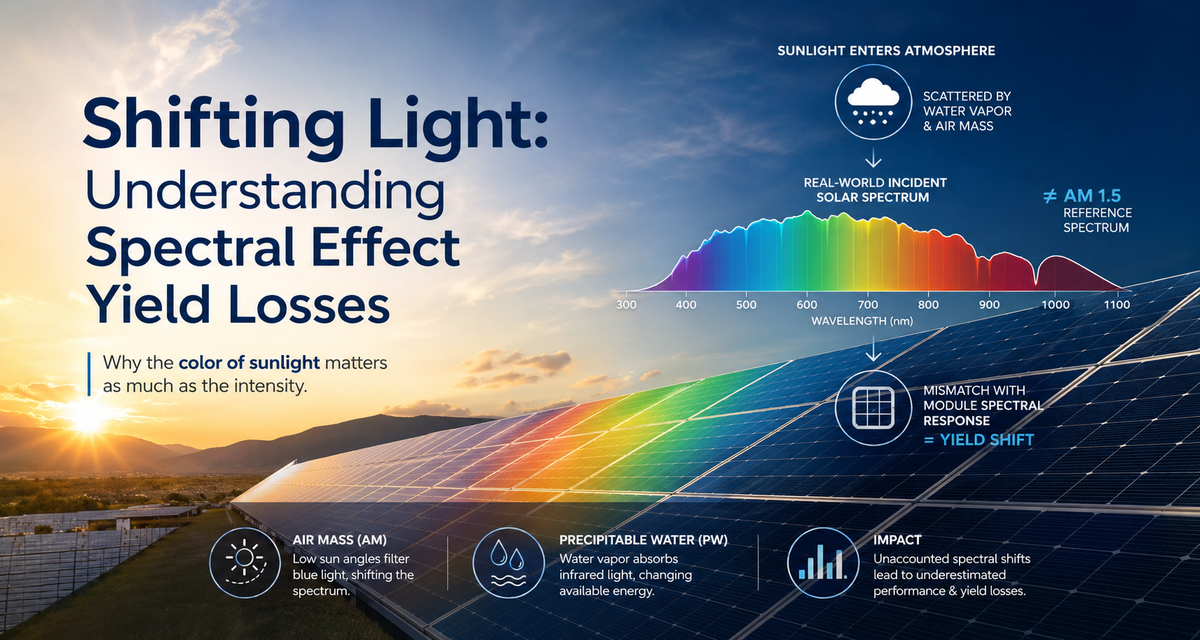
When measuring the efficiency of utility-scale solar assets, the industry heavily relies on a set of standardized benchmarks known as Standard Test Conditions (STC). Under STC, every solar panel is rated under a fixed flash tester environment: an irradiance of 1000 W/m², a cell temperature of 25°C, and an Air Mass (AM 1.5) reference spectrum.
However, the real world is not a laboratory flash tester. The sunlight hitting your arrays changes color—or spectrum—every single hour of the day.
Spectral effect yield losses represent a Medium Severity operational phenomenon where variations in the outdoor light spectrum mismatch your equipment's engineering profiles. If unaccounted for, these shifts can distort your capacity tests, bias your performance metrics, and create a persistent gap in your realized energy yield. At HelioExpect, we believe that closing the solar yield gap requires an intimate understanding of how changing atmospheric physics alters module performance.
The Science: How Atmospheric Shifts Alter the Spectrum
Every photovoltaic (PV) technology, whether it is traditional Monocrystalline Silicon, Thin-Film (CdTe), or next-generation Tunnel Oxide Passivated Contact (TOPCon)—has a unique module spectral response. This determines exactly which wavelengths of light (from ultraviolet to infrared) the cell can efficiently convert into electricity.
[ Sunlight Enters Atmosphere ]
│
(Scattered by Water Vapor & Air Mass)
│
▼
[ Real-World Incident Solar Spectrum ]
≠ [ AM 1.5 Reference Spectrum ]
│
▼
[ Mismatch with Module Spectral Response = Yield Shift ]
The light spectrum reaching your panels shifts constantly due to key atmospheric variables:
- Air Mass (AM): In the early morning or late afternoon, sunlight travels a longer path through the Earth's atmosphere. This filters out blue light, shifting the incident solar spectrum toward the red and infrared wavelengths.
- Precipitable Water (PW): Water vapor in the air absorbs specific bands of infrared light. High humidity or heavy cloud cover alters the available spectrum, directly impacting how much usable light hits the semiconductor layer.
If your plant's modules are optimized for an AM 1.5 spectrum, but the site frequently experiences high humidity or low sun angles, the modules will produce less current than predicted—even if your standard pyranometer says the irradiance is perfectly sufficient.
Detection Method: Isolating Spectral Shifts from Sensor Noise
Detecting a spectral yield loss is uniquely challenging because it mimics other forms of underperformance. If your plant is producing 2% less power than your baseline model suggests on a humid afternoon, is it due to a dirty panel, a hot inverter, or a spectral mismatch?
To accurately isolate spectral effects, performance analytics must cross-reference multiple atmospheric and hardware datasets:
- Spectral Irradiance vs. Broad-Band Data: Compare measurements from standard broadband pyranometers against filtered spectral irradiance sensors or spectroradiometers.
- Air Mass Tracking: Programmatically calculate real-time sun angles and Air Mass coefficients for the exact GPS coordinates of the asset.
- Precipitable Water Modeling: Integrate local meteorological humidity profiles and atmospheric moisture data into the performance analysis pipeline.
- Technology-Specific Benchmarking: Map the actual output against the known quantum efficiency curves of your specific module technology response.
- Temperature-Corrected Output Residuals: Eliminate thermal losses by applying rigorous temperature-correction algorithms. If a performance deficit remains that correlates tightly with the time of day and humidity levels, a spectral mismatch is confirmed.
Mitigation: Adjusting the Models to Match Reality
Because you cannot change the color of the sun, mitigating spectral losses is entirely an exercise in mathematical precision, testing accuracy, and baseline calibration.
1. Apply Advanced Spectral Corrections in Testing
During pre-construction commissioning or post-construction performance testing, ensure that all capacity tests apply rigorous spectral corrections. Relying on uncorrected raw irradiance data can unfairly penalize a EPC contractor or lead asset owners to believe their physical hardware is failing when the issue is simply an uncalibrated baseline.
2. Utilize Technology-Specific Spectral Response Data
When building or updating your plant's digital twin or energy yield prediction software (such as PVsyst), move away from generic "silicon" defaults. Populate your models with verified, manufacturer-certified spectral response data unique to your exact module model.
3. Disentangle Spectral Losses from Systemic Anomalies
To prevent your O&M teams from executing unnecessary field interventions, your analytics framework must separate spectral variations from other independent loss categories. Ensure your software can cleanly distinguish a spectral shift from:
- Temperature Losses: High-temperature power degradation.
- Granular Dust & Soiling Losses: Physical blockages on the glass surface.
- Long-Term Module Degradation: Linear component aging.
- Irradiance Sensor Bias: Calibration drift in your baseline weather sensors.
Master Your Performance Intelligence with HelioExpect
Spectral effect losses prove that solar asset management is not a static discipline. The atmosphere is dynamic, and your data analytics must be equally sophisticated. At HelioExpect, we specialize in cutting through the atmospheric noise.
By combining high-precision solar forecasting, localized environmental tracking, and deep spectral analysis, we ensure you always have an honest, unassailable baseline of your plant's true capability. Stop guessing at the gaps in your performance ratio—align your data with reality and maximize your portfolio yield.