The Green Threat: How Fungal Soiling Causes Persistent Solar Yield Losses


When solar asset managers think of soiling losses, they usually picture dust, sand, or industrial particulate matter. These airborne materials settle on PV modules, block global horizontal irradiance (GHI), and are typically washed away by the next heavy rainfall or a standard maintenance cycle.
However, there is a far more stubborn, living threat quietly expanding across utility-scale and commercial solar portfolios: fungal soiling.
Unlike standard dust, biological contamination does not behave predictably. It actively clings to the module surface, creates severe localized mismatches, and refuses to wash away with a light rain. At HelioExpect, we classify fungal soiling as a Medium Severity threat, but its long-term impact on your performance ratio (PR) can be devastating if left unchecked.
What is Fungal Soiling and Why is it Different?
Fungal soiling occurs when microscopic fungal spores, often combined with algae, pollen, and airborne organic matter, settle on the glass surface of photovoltaic modules.
In environments with high relative humidity, frequent morning dew, or proximity to agricultural zones, these spores find the perfect breeding ground. They feed on organic dust particles and form a resilient, sticky matrix known as a biofilm.
The Unique Danger of Biological Contamination:
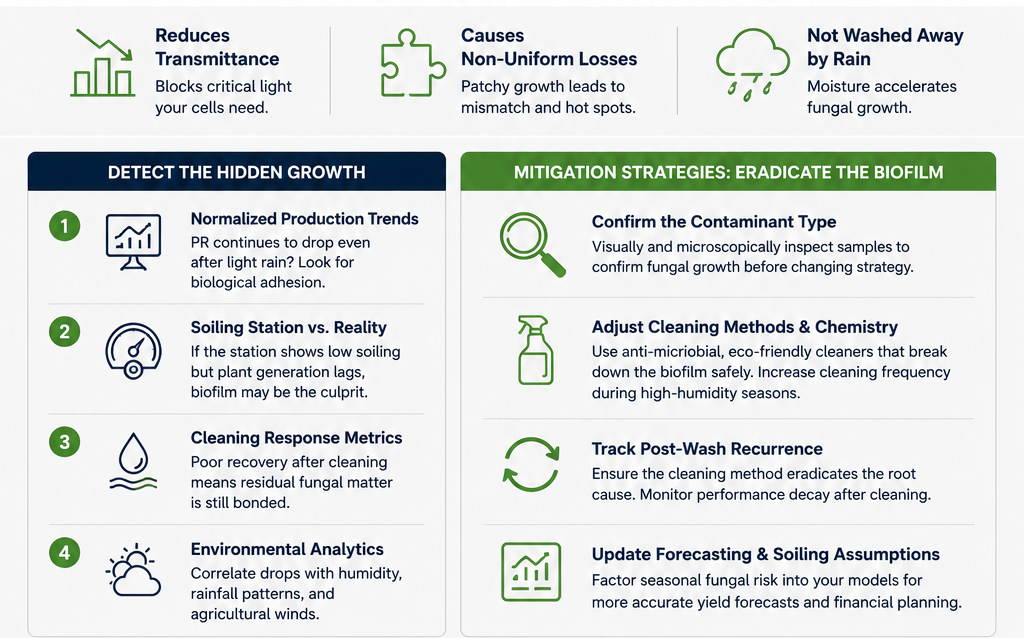
- The Transmittance Trap: Fungal growth directly reduces glass transmittance, blocking the spectrum of light your solar cells need most to generate electricity.
- Non-Uniform Soiling: Dust distributes relatively evenly across a row of panels. Fungi, however, grow in patchy, dense clusters. This creates severe non-uniform soiling, leading to localized mismatch losses within the module strings.
- The No-Reset Factor: This is the most critical differentiator. While a brief rain shower resets ordinary dust losses to zero, it actually accelerates fungal growth by providing the moisture the biological deposits need to multiply.
Detecting the Hidden Growth: Data vs. Reality
Because fungi can blend in with dark solar glass or look like standard dirt from a distance, physical identification often happens too late. Asset owners must combine digital intelligence with physical field data to catch it early.
To accurately detect fungal and persistent biological contamination, operators should employ a multi-layered verification approach:
- Normalized Production Trends: Monitor daily string-level data. If your performance ratio continues a downward trend immediately after a light rain event, it is a primary indicator of biological adhesion.
- Soiling Station Measurements vs. Reality: If your local soiling station (which might use a different glass type or automated cleaning) shows low soiling, but the actual plant generation is lagging, a sticky biofilm may be the culprit.
- Cleaning Response Metrics: Track the system's recovery rate immediately following a standard wash. If the post-cleaning performance does not return to the expected baseline, residual fungal matter is likely still bonded to the glass.
- Environmental Analytics: Correlate performance drops with local humidity conditions, historical rainfall patterns, and agricultural wind data.
Mitigation Strategies: Eradicating the Biofilm
When biological deposits behave differently from ordinary dust, your standard operations and maintenance (O&M) playbook will fail. You cannot simply spray water and expect the yield gap to close.
Here is how utility-scale operators must respond:
Confirm the Contaminant Type
Before changing your operational strategy, conduct a visual and microscopic inspection of sample modules. Confirming whether the residue is mineral dust, bird droppings, or fungal growth dictates the exact cleaning chemistry required.
Adjust Cleaning Methods and Chemistry
Standard mechanical brushing with pure water is rarely enough to break down a matured biofilm. Operators must introduce specialized, anti-microbial, eco-friendly cleaning agents that safely dissolve the fungal matrix without damaging the anti-reflective coating (ARC) on the PV glass. Furthermore, cleaning frequencies must be accelerated during high-humidity seasons to disrupt the fungal growth cycle.
Track Post-Wash Recurrence
Fungal spores are resilient. If the cleaning method does not completely eradicate the root system, the biofilm will regenerate rapidly. Track the performance decay rate post-cleaning to ensure the mitigation strategy actually worked.
Update Solar Forecasting and Soiling Assumptions
If your asset is prone to seasonal fungal outbreaks, your financial and performance models must reflect this reality. Work with your solar forecasting company to update baseline soiling assumptions within your predictive models, ensuring that localized biological trends are factored into your expected yield outputs.
Protect Your Yield with Predictive Intelligence
Fungal soiling proves that solar asset management is not a static science. Biological variables require dynamic, real-time data tracking. By aligning advanced operational soiling analysis with high-precision solar forecasting, HelioExpect helps you identify these anomalies before they cement themselves onto your modules.
What’s Next in Our Series? Fungal growth is just one piece of the puzzle. Stay tuned for our upcoming mini-blogs where we will dive into other persistent soiling types, advanced sensor calibration, and automated mitigation technologies designed to keep your portfolios operating at peak efficiency.