The Phantom Yield Gap: How Flawed PAN Files Silently Drain Your Solar ROI

f you manage utility-scale solar assets, you know the drill. You pull up your monthly performance ratio (PR) data, compare it to your initial bankable yield simulations, and notice a chronic, unexplained deficit. The weather models look accurate, the panels are clean, and the inverters are humming along without error codes. Yet, the generation metrics are consistently lagging.
What if the asset isn’t physically breaking down, but the math used to predict its performance was flawed from day one? Welcome to one of the most elusive root causes of PV underperformance: flawed PAN files.
What is a PAN File, and Why Does It Matter? In solar asset management and project development, PVsyst is the industry standard software used to simulate energy yield predictions. To model how a specific solar module will behave in the real world, PVsyst relies on a text-based component file with a .PAN extension.
A PAN file contains the mathematical DNA of a solar panel. It maps out how a module reacts under various dynamic outdoor conditions using the one-diode circuit model. It dictates how the panel processes:
● Standard Test Conditions (STC): The baseline performance rating (e.g., 450W at 25°C).
● Low-Light Irradiance Matrix: How efficiently the cell converts sunlight when light levels drop below 400 W/m (cloudy days, early mornings, late evenings).
● Temperature Coefficients: The rate at which power output drops as the module heats up.
● Incident Angle Modifier (IAM): The optical losses that occur as the sun hits the panel glass at oblique angles.
If these parameters are meticulously accurate, your simulation matches reality. But if the PAN file is corrupted, generic, or artificially bloated, your entire financial model is built on a foundation of sand.

The Anatomy of a Flawed PAN File
The solar yield gap caused by PAN files rarely stems from software bugs. Instead, it comes down to data integrity. There are two primary ways flawed PAN data sneaks into bankable reports:
1. Overly Optimistic Manufacturer Tuning
Solar manufacturing is a fiercely competitive landscape. To make their modules look superior in pre-construction bids, some manufacturers provide PAN files tuned to absolute best-case lab scenarios—or worse, unverified default values. They might slightly tweak the series resistance (Rs) or shunt resistance (Rsh) parameters, creating a hyper-optimistic performance profile that real-world silicon cannot achieve.
2. The Missing Low-Light Matrix
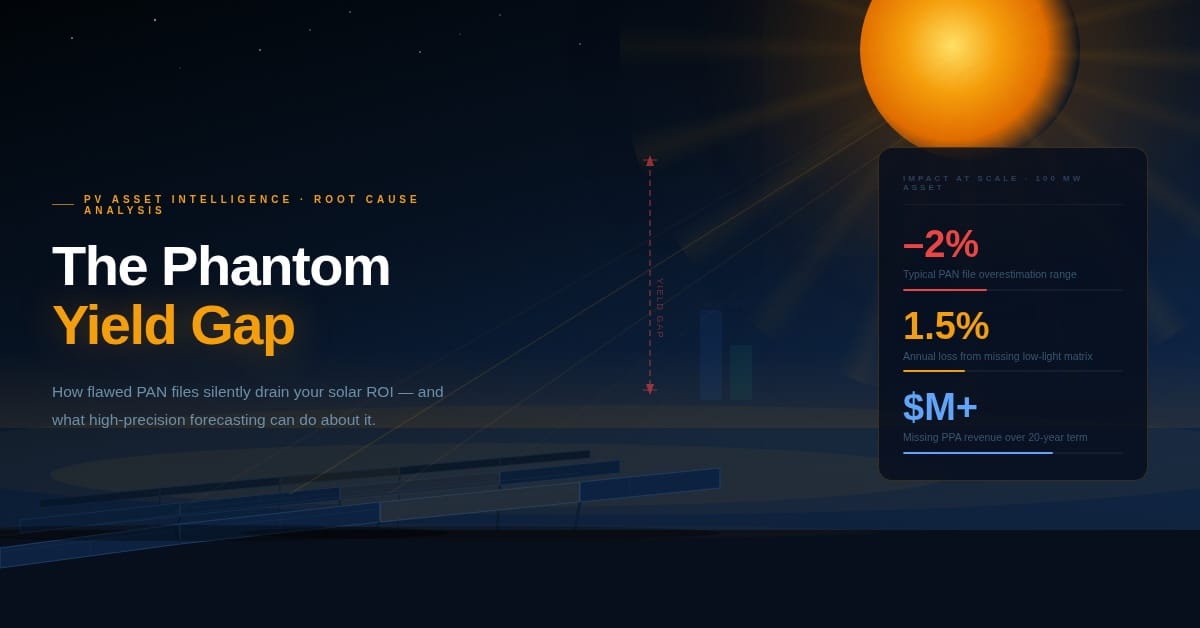
A standard datasheet tells you how a panel performs at 1000 W/m. It does not tell you how it behaves at 200 W/m. If a PAN file lacks a verified low-light performance matrix based on rigorous laboratory standards (like IEC 61853-1), PVsyst is forced to estimate. This default math often glosses over severe efficiency drops in low-light conditions, leading to an overestimation of shoulder-hour generation by up to 1.5% annually.
The Financial Fallout: Paper Gains vs. Field Losses
When a PAN file overestimates a module's real-world efficiency by just 1% to 2%, it may seem negligible on paper. However, across a 100 MW utility-scale solar asset, that minor discrepancy translates to millions in missing revenue over a 20-year Power Purchase Agreement (PPA).
More importantly, it creates an operations and maintenance (O&M) nightmare. Because the pre-construction simulation model is artificially high, the plant will permanently trigger "underperformance" alarms. Your O&M teams will waste countless hours searching for physical faults, checking string connections, hunting for potential-induced degradation (PID), or washing clean panels when the real culprit is a ghost in the software.
How to Solve the PAN File Problem
Reclaiming your solar asset's actual ROI requires a shift from passive monitoring to predictive data validation.
● Demand Third-Party Validation: Never accept a proprietary PAN file blindly. Ensure the file's parameters are backed by independent, certified testing laboratories (such as PVEL, RETC, or Fraunhofer).
● Audit the IAM and Thermal Coefficients: Look closely at the Incident Angle Modifier values. If a manufacturer claims an unrealistic optical performance at an 80° sun angle, flag it.
● Leverage Dynamic Solar Forecasting: Static models cannot keep up with changing atmospheric realities. By aligning verified module parameters with high-resolution satellite data and real-time irradiance modeling, you can establish an ironclad, honest baseline.
At HelioExpect, we specialize in cutting through the noise of overly optimistic projections. By replacing generic assumptions with high-precision solar forecasting and performance intelligence, we help you close the solar yield gap and ensure that what you see on your simulation reports is exactly what you get at the grid connection point.