Solar Optimization: Complete Implementation Guide 2026
A comprehensive service guide covering solar optimization services across global markets including Bengaluru, Mumbai, and Ahmedabad. This guide explains what solar optimization includes (AI-powered forecasting, predictive maintenance, performance tracking), the implementation process, expected outco


Solar energy has evolved from simple generation to sophisticated, data-driven operations. In 2026, solar optimization represents the next frontier for asset owners seeking to maximize returns and operational efficiency. Whether you're managing solar portfolios in Bengaluru, Mumbai, Ahmedabad, or anywhere across global markets, intelligent optimization strategies can transform your solar assets from passive generators into actively managed, high-performing investments.
This comprehensive guide explores everything you need to know about solar optimization services, from AI-powered forecasting and predictive maintenance to implementation processes and provider evaluation. By the end, you'll understand how leading solar operators achieve 30-50% downtime reduction and 98% forecast accuracy through strategic optimization approaches.
What Is Solar Optimization and Why It Matters in 2026
Solar optimization is the systematic application of advanced technologies—including artificial intelligence, machine learning, and real-time data analytics—to maximize the performance, reliability, and financial returns of solar energy assets. Unlike basic monitoring systems that simply report what happened, solar optimization actively predicts, prevents, and resolves issues before they impact production.

The evolution from traditional monitoring to intelligent optimization represents a fundamental shift in how solar assets are managed. Early solar monitoring systems provided reactive insights, alerting operators only after problems occurred. Modern solar optimization platforms leverage predictive algorithms to identify potential failures days or weeks in advance, enabling proactive maintenance that prevents costly downtime.
The business case for solar optimization has never been stronger. Solar asset owners face mounting pressure to maximize ROI while managing increasingly complex portfolios. Unplanned downtime can cause 30-50% operational losses, while inaccurate energy forecasting leads to grid scheduling errors and financial penalties. In competitive markets like Bengaluru, Mumbai, and Ahmedabad, where solar capacity continues to expand rapidly, optimization capabilities separate high-performing assets from underperforming ones.
Key performance metrics that define successful solar optimization include:
- Downtime reduction: Preventing 30-50% of operational losses through predictive maintenance
- Forecast accuracy: Achieving 98% reliability in energy production predictions
- Component health visibility: Real-time tracking from plant level down to individual strings
- Alert intelligence: Reducing false positives while catching critical issues early
- Maintenance efficiency: Optimizing service schedules based on predictive insights
For solar energy traders and grid operators, accurate forecasting enables better energy trading decisions and helps avoid penalties from forecast deviations. For asset owners and operators, predictive maintenance capabilities translate directly to reduced operational costs and improved asset longevity.
Core Components of Solar Optimization Services
Comprehensive solar optimization services integrate multiple technologies and capabilities into a unified platform. Understanding these core components helps asset owners evaluate solutions and set realistic expectations for implementation outcomes.
AI-Powered Solar Forecasting
Modern solar forecasting leverages artificial intelligence to predict energy production with unprecedented accuracy. Advanced platforms use technologies like GraphCast and cloud motion vectors to analyze weather patterns, historical performance data, and real-time conditions. These AI models generate forecasts across multiple time horizons, from 15-minute intraday predictions to 14-day advance forecasts.
The accuracy of solar forecasting directly impacts grid scheduling, energy trading profitability, and penalty avoidance. Leading platforms achieve 98% forecast accuracy by continuously learning from actual production data and refining their predictive models. This level of precision enables grid operators to balance supply and demand more effectively, while energy traders can make confident decisions about market positions.
Applications of AI-powered solar forecasting include:
- Grid scheduling: Providing utilities with reliable production forecasts for load balancing
- Energy trading: Enabling traders to optimize market positions based on predicted generation
- Penalty avoidance: Reducing financial penalties from forecast deviations
- Maintenance planning: Scheduling service activities during predicted low-production periods
- Portfolio management: Aggregating forecasts across multiple sites for comprehensive planning
For solar operators in regions with variable weather patterns, such as monsoon-affected areas in Mumbai or Bengaluru, accurate forecasting becomes even more critical. AI models trained on local weather data can account for regional climate characteristics, improving prediction reliability.
Predictive Maintenance and Health Scoring
Predictive maintenance represents one of the most valuable components of solar optimization. Rather than waiting for equipment failures or relying on fixed maintenance schedules, predictive maintenance uses machine learning algorithms to identify potential issues before they cause downtime.
Advanced platforms implement 0-100% health scoring systems that continuously evaluate component condition. These scores aggregate multiple data points—including performance trends, environmental factors, and historical failure patterns—to provide actionable insights about equipment health. When a component's health score drops below critical thresholds, the system generates intelligent alerts that prioritize maintenance activities.
Component-level tracking extends across the entire solar infrastructure:
- Inverters: Monitoring efficiency, temperature, and performance degradation patterns
- String combiner boxes (SCBs): Tracking current imbalances and connection issues
- Individual strings: Identifying underperforming panels or wiring problems
- Transformers: Detecting thermal issues and load imbalances
- Monitoring equipment: Ensuring data collection systems remain operational
The financial impact of predictive maintenance is substantial. By preventing 30-50% of unplanned downtime, solar operators reduce emergency repair costs, extend equipment lifespan, and maintain consistent energy production. Early failure detection also enables more efficient maintenance scheduling, allowing teams to address multiple issues during planned service visits rather than making repeated emergency trips.
Performance Tracking and Real-Time Monitoring
Comprehensive solar performance tracking provides visibility into asset operations at every level. Multi-level monitoring architectures track performance from portfolio level down to individual strings, offering different views for different stakeholders. Executive teams might focus on portfolio-wide metrics and financial performance, while operations teams need component-level details for troubleshooting.
Modern platforms offer 74+ visualization types, enabling users to analyze data through the lens most relevant to their needs. These visualizations include time-series performance graphs, heat maps showing spatial performance patterns, comparison charts for benchmarking, and geographic views for portfolio management.
Real-time data collection and processing ensure that operators have current information for decision-making. However, effective solar monitoring balances real-time updates with intelligent data aggregation to avoid overwhelming users with excessive detail. The platform should surface critical information while making deeper analysis available when needed.
Delivery methods for monitoring data vary based on user preferences and workflow requirements:
- Dashboard interfaces: Web-based platforms for interactive analysis and exploration
- Email reports: Automated summaries delivered on customizable schedules
- FTP/SFTP integration: Direct data feeds for enterprise systems and custom analytics
- Mobile access: Remote monitoring capabilities for field teams and executives
- API connectivity: Integration with existing business intelligence and asset management systems
The flexibility to access monitoring data through multiple channels ensures that different team members can work within their preferred environments while maintaining a single source of truth for performance data.
The Solar Optimization Implementation Process
Successful solar optimization implementation follows a structured process that ensures smooth integration, accurate configuration, and effective team adoption. While specific timelines vary based on portfolio size and complexity, the fundamental steps remain consistent across deployments.

Step 1: Assessment and Baseline Performance Analysis
Implementation begins with a comprehensive assessment of current solar asset performance. This baseline analysis examines historical production data, identifies existing performance gaps, and establishes benchmarks for measuring improvement. The assessment phase typically includes site surveys, data quality evaluation, and stakeholder interviews to understand operational workflows and pain points.
Key activities during assessment include:
- Reviewing historical performance data and identifying patterns
- Documenting current monitoring and maintenance processes
- Evaluating data collection infrastructure and connectivity
- Identifying specific optimization goals and success metrics
- Assessing team capabilities and training needs
For portfolios spanning multiple locations—such as assets distributed across Bengaluru, Mumbai, and Ahmedabad, the assessment phase may reveal regional performance variations that inform optimization strategies.
Step 2: Platform Integration and Data Connectivity
Once baseline performance is established, the technical integration phase connects the optimization platform to existing solar infrastructure. This involves configuring data collection from inverters, weather stations, and other monitoring equipment. Modern platforms support multiple communication protocols and can integrate with diverse equipment manufacturers.
Data connectivity considerations include:
- Establishing secure communication channels between solar sites and the cloud platform
- Configuring data collection intervals appropriate for different metrics
- Implementing data validation and quality checks
- Setting up backup communication paths for reliability
- Integrating with existing enterprise systems through APIs or file transfers
The integration phase typically takes 2-4 weeks for standard deployments, though complex portfolios with legacy equipment may require additional time for custom integration development.
Step 3: AI Model Training and Calibration
AI-powered forecasting and predictive maintenance algorithms require training on site-specific data to achieve optimal accuracy. During this phase, machine learning models analyze historical performance patterns, weather correlations, and equipment behavior to build predictive capabilities tailored to each solar asset.
Model training involves:
- Feeding historical production and weather data into AI algorithms
- Validating model predictions against actual outcomes
- Refining algorithms based on site-specific characteristics
- Establishing baseline health scores for all monitored components
- Testing forecast accuracy across different time horizons
Initial model training typically requires 30-90 days of data collection, though platforms can begin providing value with preliminary models while continuing to refine accuracy over time. The continuous learning nature of modern AI means that forecast accuracy and predictive maintenance capabilities improve as the system accumulates more operational data.
Step 4: Alert Configuration and Threshold Setting
Intelligent alerting separates effective solar optimization from systems that create alert fatigue. During configuration, operators define alert thresholds, severity levels, and notification routing based on their operational priorities and team structure.
Alert configuration best practices include:
- Establishing four severity levels: critical, high, medium, and low priority
- Defining escalation paths for unacknowledged critical alerts
- Configuring notification channels (email, SMS, dashboard) based on alert severity
- Setting component-specific thresholds that account for normal performance variation
- Implementing alert suppression rules to prevent notification storms during known issues
Effective alert configuration balances sensitivity, catching real issues early, with specificity, avoiding false positives that train teams to ignore notifications. This balance typically requires iterative refinement during the first few months of operation.
Step 5: Team Training and Knowledge Transfer
Technology alone doesn't optimize solar assets; people do. Comprehensive training ensures that operations teams, maintenance technicians, and management understand how to leverage optimization capabilities effectively. Training programs should address different user roles and skill levels, from executives reviewing portfolio dashboards to technicians using predictive maintenance insights for field work.
Training components include:
- Platform navigation and dashboard customization
- Interpreting health scores and predictive maintenance alerts
- Using forecast data for operational planning
- Generating reports and analyzing performance trends
- Troubleshooting common issues and accessing support resources
Effective training combines initial intensive sessions with ongoing support and refresher programs as teams gain experience with the platform.
Step 6: Ongoing Optimization and Continuous Improvement
Solar optimization is not a one-time implementation but an ongoing process of refinement and improvement. Regular performance reviews identify opportunities to enhance forecasting accuracy, refine alert thresholds, and optimize maintenance strategies based on accumulated operational data.
Continuous improvement activities include:
- Monthly performance reviews comparing actual outcomes to predictions
- Quarterly optimization sessions to refine alert configurations
- Annual strategic reviews to assess ROI and identify expansion opportunities
- Ongoing model retraining as equipment ages and performance characteristics change
- Integration of new capabilities and features as the platform evolves
Organizations that treat solar optimization as a continuous improvement process rather than a static implementation achieve significantly better long-term results.
Expected Outcomes and Performance Benchmarks
Understanding realistic performance expectations helps solar asset owners evaluate solar optimization investments and measure success. While specific outcomes vary based on baseline performance and implementation quality, industry benchmarks provide useful reference points.
Downtime Reduction: 30-50% Operational Loss Prevention
The most significant financial impact of solar optimization comes from preventing unplanned downtime. Predictive maintenance capabilities enable operators to identify and address potential failures before they cause production losses. Industry data shows that well-implemented optimization platforms prevent 30-50% of operational losses that would otherwise occur from equipment failures.
This downtime reduction translates directly to increased energy production and revenue. For a 10 MW solar plant generating at a 20% capacity factor with electricity prices of $0.08/kWh, preventing 40% of typical downtime could add $140,000 or more in annual revenue, depending on baseline reliability.
Forecast Accuracy: 98% Prediction Reliability
Advanced AI-powered solar forecasting platforms achieve 98% accuracy across multiple time horizons. This level of precision enables confident decision-making for grid scheduling and energy trading while minimizing penalties from forecast deviations.
Forecast accuracy varies by time horizon:
- 15-minute to 1-hour forecasts: 98-99% accuracy for intraday grid balancing
- Day-ahead forecasts: 95-98% accuracy for next-day planning
- Week-ahead forecasts: 90-95% accuracy for maintenance scheduling
- 14-day forecasts: 85-90% accuracy for strategic planning
The financial value of improved forecast accuracy depends on specific market conditions and penalty structures, but operators in markets with strict deviation penalties can save hundreds of thousands of dollars annually through more accurate predictions.
ROI Timeline and Payback Period
Most solar optimization implementations achieve positive ROI within 12-24 months. The payback period depends on several factors, including baseline performance, portfolio size, and the specific optimization capabilities deployed. Larger portfolios typically achieve faster payback due to economies of scale, while assets with significant existing performance issues see more dramatic improvements.
ROI drivers include:
- Increased energy production from reduced downtime
- Lower maintenance costs through optimized scheduling
- Reduced penalty payments from improved forecast accuracy
- Extended equipment lifespan from proactive maintenance
- Improved energy trading profitability from better predictions
- Reduced labor costs through automated reporting and intelligent alerting
Maintenance Cost Reduction and Efficiency Gains
Beyond preventing downtime, solar optimization reduces maintenance costs through more efficient service scheduling. Predictive insights enable maintenance teams to address multiple issues during planned visits rather than making repeated emergency trips. This consolidation reduces travel costs, minimizes site disruption, and allows better resource planning.
Maintenance efficiency improvements include:
- 30-40% reduction in emergency service calls
- 20-30% decrease in overall maintenance costs
- Improved spare parts inventory management through failure prediction
- Better contractor scheduling and resource utilization
- Extended equipment lifespan through proactive care
Grid Penalty Avoidance and Trading Optimization
For solar operators participating in energy markets or subject to grid scheduling requirements, forecast accuracy directly impacts financial performance. Deviation penalties can be substantial, particularly in markets with strict balancing requirements. Accurate forecasting helps operators avoid these penalties while enabling more profitable energy trading strategies.
Real-world performance metrics from global deployments demonstrate the value of comprehensive solar optimization. Asset owners report not only improved financial performance but also better operational visibility, reduced stress on maintenance teams, and increased confidence in long-term asset performance.
Solar Optimization Service Delivery Methods
Modern solar optimization platforms deliver capabilities through flexible SaaS models that accommodate diverse operational workflows and technical environments. Understanding delivery options helps organizations select solutions that integrate smoothly with existing processes.
SaaS Platform Delivery and Cloud-Based Access
Cloud-based SaaS delivery provides several advantages for solar optimization. Users access the platform through web browsers without installing local software, ensuring everyone works with the latest version and features. Cloud infrastructure scales automatically to accommodate growing portfolios, and data remains accessible from anywhere with internet connectivity.
SaaS delivery benefits include:
- Automatic updates and feature enhancements without user intervention
- Scalable infrastructure that grows with your portfolio
- Reduced IT overhead compared to on-premise solutions
- Built-in redundancy and disaster recovery
- Accessible from any device with a web browser
Dashboard Interfaces for Different User Roles
Effective platforms provide role-based dashboards tailored to different user needs. Executives need high-level portfolio views and financial metrics, operations managers require detailed performance analysis, and maintenance technicians need component-level diagnostic information. Role-based interfaces ensure each user sees relevant information without unnecessary complexity.
Dashboard customization capabilities allow users to configure views based on their specific priorities, creating personalized workspaces that streamline daily workflows.
Automated Email Reporting and Alerts
While dashboard interfaces provide interactive analysis capabilities, automated email reporting ensures stakeholders receive regular updates without logging into the platform. Customizable report schedules deliver daily operations summaries, weekly performance reviews, or monthly executive reports directly to recipients' inboxes.
Email alerts provide real-time notifications for critical issues, ensuring rapid response to problems that require immediate attention. Alert routing rules direct notifications to appropriate team members based on issue type and severity.
FTP/SFTP Integration for Enterprise Systems
Organizations with existing business intelligence, asset management, or enterprise resource planning systems benefit from direct data integration. FTP and SFTP delivery methods provide automated data feeds that populate external systems with solar performance information, enabling consolidated reporting across diverse asset types.
API integration offers even more flexible connectivity, allowing custom applications to query real-time data, submit configuration changes, or trigger specific platform actions programmatically.
Mobile Access and Remote Monitoring Capabilities
Mobile-optimized interfaces enable field teams and executives to monitor solar assets from smartphones and tablets. This remote access capability proves particularly valuable for maintenance technicians who need diagnostic information while on-site, or executives who want to check portfolio performance while traveling.
Mobile capabilities typically include:
- Real-time performance dashboards optimized for small screens
- Alert notifications with one-tap acknowledgment
- Component health scores and diagnostic information
- Forecast data for planning field activities
- Photo upload and annotation for maintenance documentation
How to Evaluate Solar Optimization Providers
Selecting the right solar optimization provider significantly impacts implementation success and long-term value. A structured evaluation process helps asset owners compare options and identify solutions that best match their specific needs.

Key Criteria: Forecasting Accuracy and Validation Methods
Forecast accuracy claims should be supported by transparent validation methodologies. Ask providers to explain how they measure accuracy, what time horizons they support, and whether their benchmarks come from real-world deployments or theoretical models. Request case studies or references from similar solar assets in comparable climate regions.
Evaluation questions include:
- What AI technologies and algorithms power your forecasting engine?
- How do you validate forecast accuracy, and what metrics do you use?
- What forecast horizons do you support, from intraday to multi-day predictions?
- How does your platform account for regional weather patterns and climate characteristics?
- Can you provide performance data from deployments in similar environments?
Providers offering 98% forecast accuracy should demonstrate this performance through verifiable data from actual deployments, not just laboratory testing or simulations.
Predictive Maintenance Capabilities and Health Scoring
Predictive maintenance represents a core value driver for solar optimization. Evaluate how providers implement health scoring, what data sources inform their predictions, and how they validate that predicted failures actually occur. The most effective systems combine multiple data streams, performance metrics, environmental conditions, and historical failure patterns, to generate reliable predictions.
Assessment criteria include:
- What machine learning algorithms power your predictive maintenance engine?
- How do you calculate component health scores, and what scale do you use?
- What level of granularity does your monitoring support (plant, inverter, string)?
- Can you demonstrate examples of failures predicted and prevented?
- How do you handle false positives and refine predictions over time?
Platforms claiming to prevent 30-50% of downtime should provide evidence from real deployments, including specific examples of predicted failures and the financial impact of prevention.
Platform Scalability for Portfolio Management
As solar portfolios grow, optimization platforms must scale efficiently. Evaluate whether providers can accommodate your current asset base and future expansion plans without performance degradation or architectural limitations. Cloud-based SaaS platforms generally scale more easily than on-premise solutions, but verify that the provider has experience managing portfolios of your target size.
Scalability considerations include:
- Maximum number of sites and total capacity the platform supports
- Performance characteristics as portfolio size increases
- Pricing models and how costs scale with portfolio growth
- Multi-site aggregation and portfolio-level analytics
- Geographic distribution capabilities for international portfolios
Alert Intelligence and Notification Systems
Alert fatigue undermines the value of monitoring systems. Evaluate how providers implement intelligent alerting that catches critical issues while minimizing false positives. Effective systems use machine learning to understand normal performance variation and only generate alerts for genuine anomalies.
Alert system evaluation includes:
- How many severity levels does your alert system support?
- What algorithms determine alert thresholds and detect anomalies?
- How do you prevent alert fatigue and reduce false positives?
- What notification channels do you support (email, SMS, dashboard)?
- Can users customize alert routing and escalation paths?
Request demonstrations showing how the alert system handles various scenarios, from critical equipment failures to minor performance variations.
Integration Capabilities with Existing Systems
Solar optimization platforms rarely operate in isolation. Evaluate integration capabilities with your existing asset management systems, business intelligence tools, and enterprise software. API availability, data export options, and support for standard protocols determine how easily the platform fits into your technology ecosystem.
Integration assessment includes:
- What APIs and integration methods do you provide?
- Do you support FTP/SFTP for automated data delivery?
- Can your platform integrate with our existing monitoring equipment?
- What data export formats do you support?
- Have you integrated with systems similar to ours before?
Support, Training, and Ongoing Optimization Services
Implementation success depends heavily on provider support quality. Evaluate training programs, ongoing support availability, and whether the provider offers optimization consulting to help you continuously improve performance. The best providers act as partners in your optimization journey, not just software vendors.
Support evaluation criteria include:
- What training programs do you provide for different user roles?
- What support channels and response times do you offer?
- Do you provide ongoing optimization consulting and performance reviews?
- How do you handle platform updates and feature releases?
- What documentation and self-service resources are available?
Pricing Models and Total Cost of Ownership
Understand the complete cost structure, including initial implementation fees, ongoing subscription costs, and any usage-based charges. Evaluate pricing in the context of expected ROI and payback period. The lowest-cost option rarely delivers the best value if it lacks critical capabilities or requires extensive customization.
Pricing considerations include:
- What is your pricing model (per MW, per site, flat fee)?
- What implementation and onboarding costs should we expect?
- Are there usage-based charges for data volume or API calls?
- What is included in the base subscription versus optional add-ons?
- How do costs scale as our portfolio grows?
Request detailed pricing proposals that break down all cost components, enabling accurate total cost of ownership calculations.
Regional Considerations for Global Solar Optimization
While core solar optimization principles apply universally, regional factors influence implementation strategies and expected outcomes. Understanding these considerations helps asset owners tailor optimization approaches to their specific markets.
Climate and Weather Patterns in Different Markets
Regional climate characteristics significantly impact both forecasting requirements and maintenance priorities. Monsoon-affected regions like Mumbai and Bengaluru experience dramatic seasonal weather variations that challenge forecasting algorithms. Platforms must account for these patterns to maintain accuracy during transition periods.
Desert environments face different challenges, including dust accumulation that affects panel performance and extreme temperature variations that stress equipment. Optimization strategies must address these region-specific issues through appropriate monitoring parameters and maintenance protocols.
Grid Requirements and Regulatory Compliance
Grid connection requirements vary significantly across markets. Some regions impose strict forecasting obligations with financial penalties for deviations, while others have more relaxed requirements. Understanding local regulations helps prioritize optimization capabilities and set appropriate accuracy targets.
Regulatory considerations include:
- Mandatory forecasting requirements and submission deadlines
- Deviation penalty structures and tolerance thresholds
- Data reporting obligations to grid operators or regulators
- Renewable energy certificate tracking and documentation
- ESG reporting requirements for corporate sustainability goals
Local Challenges in Bengaluru, Mumbai, and Ahmedabad
India's major solar markets each present unique optimization challenges. Bengaluru's moderate climate and strong technology infrastructure make it an ideal environment for advanced optimization deployment, though monsoon seasons require robust forecasting capabilities. Mumbai's coastal location introduces salt corrosion concerns and humidity-related equipment issues that predictive maintenance must address. Ahmedabad's hot, dry climate creates dust accumulation challenges while offering more consistent solar irradiance patterns.
Successful optimization in these markets requires:
- AI models trained on local weather data and performance patterns
- Maintenance protocols addressing region-specific equipment stressors
- Alert thresholds calibrated for local performance characteristics
- Integration with regional grid operators and market structures
- Support for local languages and time zones in user interfaces
Infrastructure and Connectivity Considerations
Reliable data connectivity forms the foundation of effective solar optimization. While urban areas generally offer robust internet infrastructure, remote solar installations may face connectivity challenges. Optimization platforms must handle intermittent connections gracefully, buffering data locally when necessary and synchronizing when connectivity resumes.
Infrastructure considerations include:
- Cellular coverage and reliability at solar sites
- Backup communication paths for critical data
- Local data buffering capabilities for intermittent connectivity
- Bandwidth requirements for real-time monitoring
- Cybersecurity measures for remote site connectivity
Common Solar Optimization Challenges and Solutions
Understanding common implementation challenges helps asset owners anticipate issues and develop mitigation strategies. While every deployment faces unique circumstances, certain challenges appear consistently across solar optimization projects.
Challenge: Alert Fatigue and False Positives
Excessive alerts train operations teams to ignore notifications, undermining the value of monitoring systems. This alert fatigue typically results from poorly configured thresholds that don't account for normal performance variation or from systems that lack intelligence to distinguish genuine issues from temporary anomalies.
Solution: Implement machine learning-based anomaly detection that understands normal performance patterns and only alerts on genuine deviations. Use multi-level severity classification to ensure critical issues receive immediate attention while lower-priority items are batched into summary reports. Regularly review alert patterns and refine thresholds based on operational experience.
Challenge: Data Quality and Connectivity Issues
Optimization platforms depend on reliable, accurate data from solar sites. Connectivity problems, sensor failures, or data collection errors can create gaps that undermine forecasting accuracy and predictive maintenance capabilities. Poor data quality also generates false alerts and reduces confidence in platform insights.
Solution: Implement robust data validation at collection points, flagging suspicious values for review. Use redundant sensors for critical measurements and establish backup communication paths. Configure the platform to distinguish between genuine performance issues and data collection problems, alerting appropriately for each. Regular data quality audits identify and address systematic issues.
Challenge: Integration with Legacy Systems
Many solar assets use older monitoring equipment that lacks modern communication protocols or API support. Integrating optimization platforms with these legacy systems can be technically challenging and may require custom development or hardware upgrades.
Solution: Work with providers experienced in legacy system integration who can develop custom connectors or recommend cost-effective hardware upgrades. In some cases, installing modern data loggers alongside existing equipment provides the necessary connectivity without replacing functional monitoring systems. Prioritize integration efforts based on asset value and expected optimization benefits.
Challenge: Team Adoption and Change Management
New optimization platforms change established workflows and require teams to learn new tools and processes. Resistance to change, particularly from experienced technicians comfortable with existing methods, can undermine implementation success even when the technology works perfectly.
Solution: Involve operations teams early in the selection and implementation process, gathering input on requirements and workflow preferences. Provide comprehensive training that demonstrates clear value for each user role. Start with pilot deployments that allow teams to gain confidence before full rollout. Celebrate early wins and share success stories that illustrate how optimization makes jobs easier and more effective.
Challenge: Balancing Automation with Human Oversight
While automation drives efficiency, completely hands-off operations can miss nuances that experienced operators would catch. Finding the right balance between automated decision-making and human oversight requires careful consideration of risk tolerance and operational complexity.
Solution: Implement graduated automation that starts with decision support and progresses to autonomous actions as confidence builds. Reserve critical decisions for human approval while automating routine tasks like report generation and data collection. Use the platform to augment human expertise rather than replace it, providing operators with better information for decision-making.
Future Trends in Solar Optimization for 2026 and Beyond
The solar optimization landscape continues evolving rapidly as new technologies mature and industry needs expand. Understanding emerging trends helps asset owners prepare for future capabilities and make forward-looking investment decisions.
Advanced AI and Machine Learning Innovations
AI technologies continue advancing, with newer models offering improved accuracy and capabilities. Deep learning architectures designed specifically for time-series forecasting show promise for even better energy predictions. Reinforcement learning approaches may enable optimization systems that automatically adjust operational parameters to maximize performance without human intervention.
Emerging AI capabilities include:
- Transfer learning that applies insights from one solar site to others
- Explainable AI that helps operators understand why predictions are made
- Federated learning that improves models while preserving data privacy
- Multi-modal AI that combines satellite imagery, weather data, and performance metrics
Integration with Energy Storage Optimization
As battery storage becomes increasingly common at solar installations, optimization platforms must expand beyond generation to include storage management. Integrated optimization considers both solar production forecasts and storage state to maximize overall system value, determining optimal charge/discharge schedules based on energy prices, grid requirements, and production predictions.
Storage optimization capabilities include:
- Coordinated forecasting of generation and consumption
- Battery health monitoring and degradation prediction
- Optimal charge/discharge scheduling for revenue maximization
- Grid services optimization for ancillary revenue streams
Blockchain for Energy Trading and Grid Management
Blockchain technologies may transform how solar energy is traded and tracked. Distributed ledger systems could enable peer-to-peer energy trading, automated settlement based on smart contracts, and transparent renewable energy certificate tracking. While still emerging, these capabilities could create new revenue opportunities for solar asset owners.
Enhanced ESG Reporting and Carbon Tracking
Corporate sustainability commitments drive demand for detailed ESG reporting from solar assets. Future optimization platforms will likely expand environmental impact tracking, providing detailed carbon offset calculations, sustainability metrics, and automated reporting aligned with emerging disclosure standards.
Autonomous Solar Operations and Self-Healing Systems
The ultimate vision for solar optimization involves autonomous operations where systems detect issues, diagnose root causes, and implement corrections without human intervention. While fully autonomous operations remain years away, incremental progress toward self-healing systems continues. Future platforms may automatically adjust inverter parameters to compensate for degraded panels, reroute power around failed components, or dispatch maintenance robots for routine cleaning and inspection.
The trajectory toward more intelligent, autonomous solar operations promises continued improvements in performance, reliability, and cost-effectiveness for solar asset owners willing to embrace advanced optimization technologies.
Maximizing Your Solar Investment Through Strategic Optimization
Solar optimization has evolved from a nice-to-have capability to an essential strategy for maximizing solar asset performance and ROI. Whether you're managing portfolios in Bengaluru, Mumbai, Ahmedabad, or anywhere across global markets, intelligent optimization transforms solar assets from passive generators into actively managed, high-performing investments.
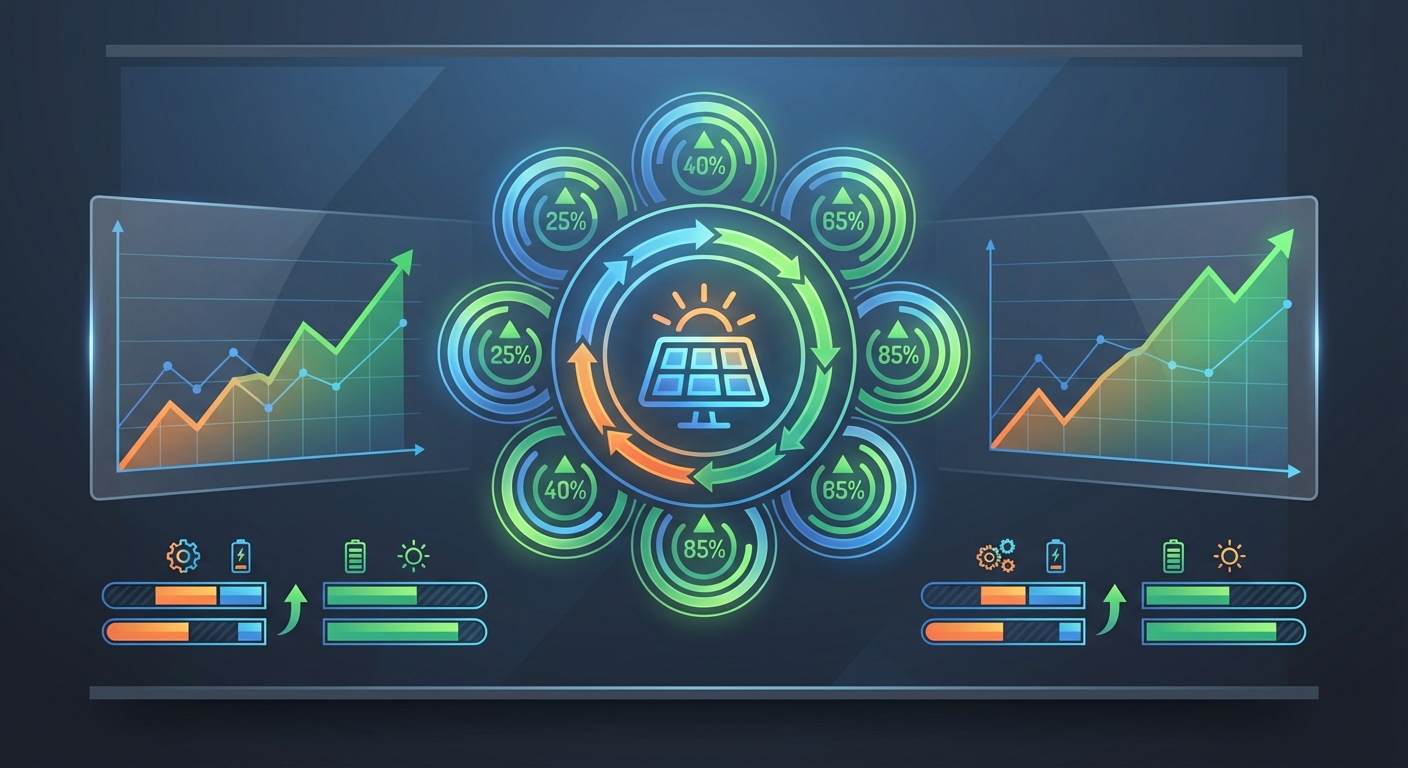
The comprehensive approach outlined in this guide, combining AI-powered forecasting, predictive maintenance, real-time monitoring, and intelligent alerting, delivers measurable results. Asset owners implementing these strategies achieve 30-50% downtime reduction, 98% forecast accuracy, and positive ROI within 12-24 months. These outcomes translate directly to increased revenue, reduced costs, and improved operational efficiency.
Success requires more than just technology deployment. Effective solar optimization demands structured implementation, ongoing refinement, and organizational commitment to continuous improvement. By following the implementation process outlined here and selecting providers based on rigorous evaluation criteria, solar asset owners position themselves for long-term success in increasingly competitive energy markets.
The future of solar energy belongs to operators who leverage data, AI, and predictive analytics to extract maximum value from their assets. As technologies continue advancing and industry best practices evolve, the gap between optimized and non-optimized solar assets will only widen. Now is the time to embrace solar optimization strategies that deliver measurable performance improvements and competitive advantages.
Ready to transform your solar assets through intelligent optimization? Explore AI-powered solar forecasting capabilities that deliver 98% accuracy across multiple time horizons, or discover predictive monitoring solutions that prevent 30-50% of operational downtime through machine learning-based maintenance. Take the first step toward maximizing your solar ROI with proven optimization strategies designed for today's competitive energy markets.
This blog post was written using thestacc.com