Predictive Maintenance Costs in Solar: 2026 ROI Analysis & Budget Planning Guide

Solar asset owners and operators face a critical decision in 2026: continue with reactive maintenance approaches that result in costly unplanned downtime, or invest in predictive maintenance solutions that prevent 30-50% of operational losses before they occur. As solar portfolios expand globally—from utility-scale installations in Bengaluru and Ahmedabad to distributed assets across Mumbai and beyond—the financial impact of this decision has never been more significant.
This comprehensive guide breaks down the complete cost structure of implementing predictive maintenance for solar assets, provides detailed ROI calculations based on real-world performance data, and offers strategic budget planning frameworks to help you make informed investment decisions. Whether you're managing a single solar plant or a distributed portfolio across multiple regions, understanding the true economics of predictive maintenance is essential for maximizing your solar ROI in today's competitive energy market.
Understanding Predictive Maintenance Investment in Solar Energy
Predictive maintenance represents a fundamental shift from traditional reactive or scheduled maintenance approaches. Instead of waiting for equipment failures or performing maintenance on fixed schedules regardless of actual equipment condition, predictive maintenance uses machine learning algorithms, real-time monitoring data, and advanced analytics to forecast component failures before they occur.
For solar energy operations, this means continuously monitoring performance at multiple levels—from entire plants down to individual strings—and using AI-powered analysis to identify degradation patterns, anomalies, and failure indicators that human operators might miss. The technology combines solar monitoring with intelligent health scoring systems that rate component condition on a 0-100% scale, enabling maintenance teams to prioritize interventions based on actual risk rather than guesswork.
The business case for this investment is compelling: traditional reactive maintenance approaches result in unplanned downtime that costs solar operators millions in lost revenue annually. When an inverter fails unexpectedly, a solar plant can lose 30-50% of its production capacity until repairs are completed—often taking days or weeks when specialized parts must be sourced and technicians scheduled. Predictive maintenance solutions prevent these catastrophic failures by identifying issues weeks or months in advance, allowing for planned interventions during low-production periods with parts pre-ordered and crews scheduled efficiently.
In 2026, the solar industry has reached a maturity point where predictive maintenance is no longer experimental technology—it's a proven operational necessity. Leading solar asset management platforms now deliver 98% forecasting accuracy and demonstrate consistent 30-50% downtime reduction across diverse portfolio types. The question for solar operators is no longer whether to invest in predictive maintenance, but how to structure that investment for maximum return.
This guide will walk you through every aspect of predictive maintenance costs, from initial platform investment through ongoing operational expenses, and provide the analytical frameworks you need to calculate expected returns for your specific portfolio characteristics.
1. The True Cost of Solar Downtime: Why Predictive Maintenance Matters
Before examining predictive maintenance costs, it's essential to understand the baseline: what does solar downtime actually cost your operation? This context transforms predictive maintenance from an optional technology upgrade into a critical financial imperative.
For a typical 50 MW utility-scale solar installation, a single day of complete downtime represents approximately $15,000-25,000 in lost revenue, depending on regional energy prices and power purchase agreement terms. However, complete plant shutdowns are rare—the more insidious problem is partial capacity losses from component failures that go undetected or unaddressed.
Consider these common downtime scenarios:
- Inverter failure: A failed inverter in a 50 MW plant typically affects 1-2 MW of capacity. If the failure goes undetected for 48 hours and takes 5 days to repair, the revenue loss exceeds $20,000 for a single incident.
- String-level issues: Underperforming strings often escape notice in traditional monitoring systems. A plant with 100 underperforming strings at 20% reduced capacity can lose $50,000-100,000 annually without obvious alarm triggers.
- Soiling and degradation: Gradual performance decline from soiling or component degradation may reduce plant output by 5-10% before triggering maintenance action, costing hundreds of thousands annually.
- Grid scheduling penalties: Inaccurate energy forecasting that fails to account for equipment issues can result in grid scheduling deviations, triggering penalties that compound revenue losses.
The hidden costs extend beyond direct revenue losses. Emergency maintenance carries premium pricing—expedited parts shipping, overtime labor rates, and contractor availability premiums can double or triple repair costs compared to planned maintenance. A $5,000 planned inverter replacement becomes a $15,000 emergency repair when failure occurs unexpectedly.
For solar portfolios distributed across multiple geographic regions, these costs multiply. Asset owners managing installations across Bengaluru, Ahmedabad, and Mumbai face additional complexity coordinating maintenance teams, managing parts inventory across locations, and responding to failures in remote installations where technician travel time adds days to repair timelines.
Industry data from 2026 shows that solar plants using reactive maintenance approaches experience average annual downtime of 3-5%, translating to 11-18 days of reduced capacity. For a 100 MW portfolio, this represents $1.5-3 million in annual lost revenue. Predictive maintenance systems that prevent 30-50% of this downtime deliver $450,000-1.5 million in annual savings—providing immediate context for evaluating platform investment costs.
2. Predictive Maintenance Cost Components: Complete Investment Breakdown
Understanding the complete cost structure of predictive maintenance implementation requires examining both upfront investment and ongoing operational expenses. Unlike traditional monitoring systems with simple licensing fees, comprehensive predictive maintenance platforms involve multiple cost components that vary based on portfolio size, monitoring depth, and integration requirements.
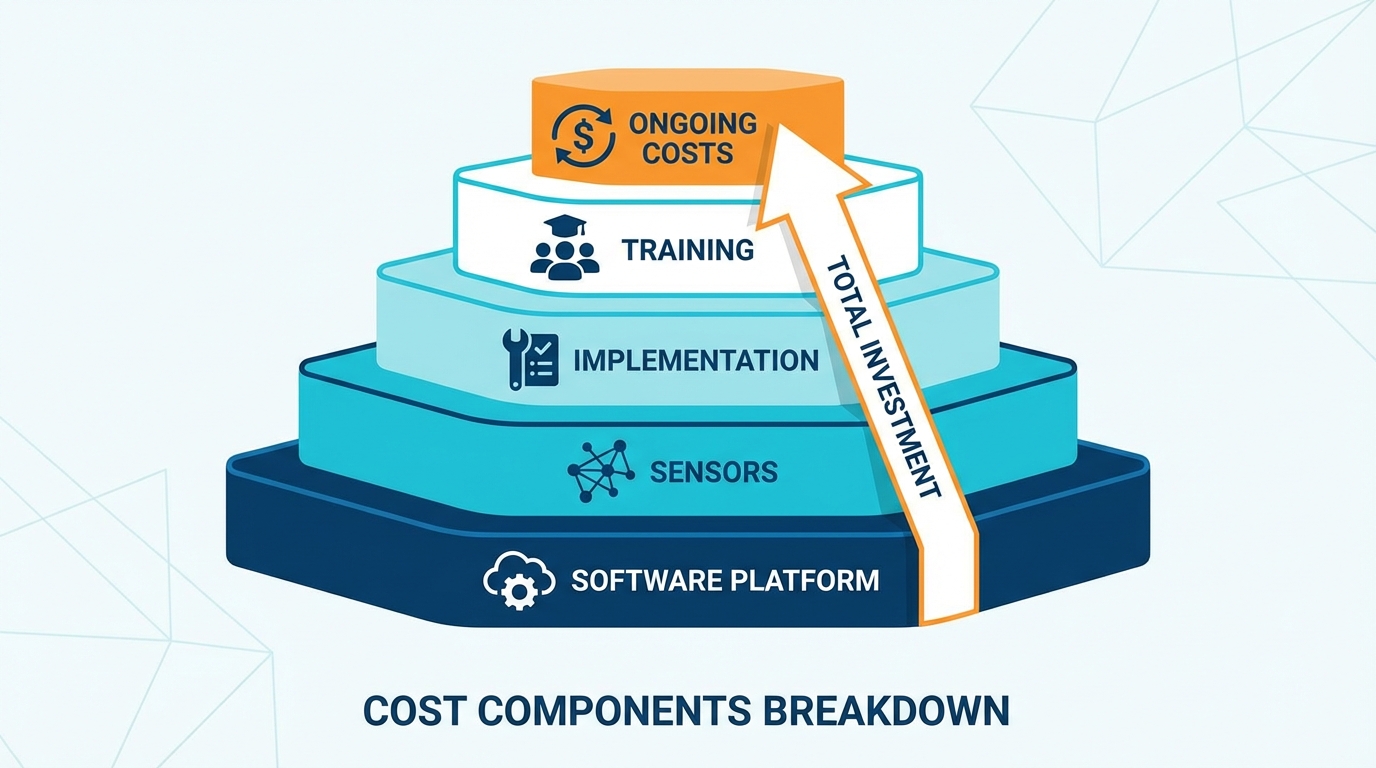
Initial Investment Requirements
The upfront investment in predictive maintenance typically includes several distinct components:
Platform licensing and setup: Enterprise solar software platforms offering predictive maintenance capabilities typically structure initial licensing based on portfolio capacity (measured in MW) or number of monitored assets. Setup fees cover platform configuration, user account creation, and initial system customization to match your operational workflows. For mid-sized portfolios (50-200 MW), initial setup investments generally range from $10,000-50,000, while larger portfolios (500+ MW) may require $75,000-150,000 in initial platform investment.
Integration with existing systems: Most solar operators already have some monitoring infrastructure in place. Integrating predictive maintenance platforms with existing SCADA systems, inverter monitoring tools, and data historians requires technical implementation work. Integration complexity varies significantly—simple API connections may require minimal investment, while complex legacy system integrations involving custom data mapping and middleware development can add $20,000-100,000 to initial costs. Modern platforms like HelioExpect that support multiple delivery methods including dashboard, email, and FTP/SFTP typically offer more flexible integration options that reduce these costs.
Hardware and sensor requirements: Advanced predictive maintenance may require additional sensors or data collection hardware beyond standard inverter monitoring. However, many modern AI-powered systems leverage existing data streams from inverters and plant controllers, minimizing additional hardware investment. When additional sensors are needed—such as weather stations for improved solar forecasting or string-level monitoring devices—hardware costs typically range from $5,000-30,000 per plant depending on size and monitoring granularity required.
Ongoing Operational Costs
The recurring cost structure of predictive maintenance platforms typically follows a subscription model with several components:
Platform subscription fees: Most enterprise solar platforms charge annual or monthly subscription fees based on monitored capacity. Pricing models vary by vendor, but typical structures range from $50-200 per MW annually for basic monitoring, scaling to $200-500 per MW annually for comprehensive predictive maintenance with ML-based health scoring, component-level tracking, and advanced solar analytics. Volume discounts typically apply for larger portfolios, with per-MW costs decreasing as total capacity increases.
Data infrastructure and connectivity: Predictive maintenance platforms require continuous data transmission from solar assets to cloud-based analytics engines. For well-connected sites, data transmission costs are minimal. However, remote installations may require cellular data plans or satellite connectivity, adding $50-200 per site monthly. Cloud data storage and processing fees are typically included in platform subscription costs, but high-frequency monitoring (sub-minute intervals) or long-term historical data retention may incur additional charges.
Support and training: Enterprise support contracts ensure access to technical assistance, platform updates, and ongoing training for operations teams. Annual support costs typically range from 15-20% of platform licensing fees. Initial training programs to onboard operations teams on predictive maintenance workflows, alert interpretation, and maintenance planning typically cost $5,000-20,000 depending on team size and training depth required.
System updates and enhancements: Leading predictive maintenance platforms continuously improve their ML algorithms, add new features, and expand monitoring capabilities. These updates are typically included in subscription fees, but major platform upgrades or custom feature development may involve additional investment. Budgeting 10-15% of annual platform costs for optional enhancements and customizations provides flexibility for evolving operational needs.
3. Traditional vs. AI-Powered Predictive Maintenance: Cost Comparison
Solar operators evaluating predictive maintenance investments must understand the fundamental cost and capability differences between traditional scheduled maintenance approaches and modern AI-powered predictive systems.
Traditional scheduled maintenance follows fixed calendars—quarterly inspections, annual inverter servicing, biannual cleaning schedules—regardless of actual equipment condition. This approach requires maintaining full-time or contracted maintenance crews, scheduling regular site visits, and performing preventive work that may be unnecessary while missing emerging issues that fall between scheduled inspections.
For a 100 MW solar portfolio, traditional maintenance typically costs $150,000-300,000 annually in direct labor and materials, plus the hidden costs of downtime from undetected issues and unnecessary maintenance interventions. Manual monitoring systems that generate basic alerts add $20,000-50,000 annually in software costs but lack the intelligence to distinguish critical issues from minor anomalies, resulting in alert fatigue where operators ignore notifications or waste time investigating false alarms.
AI-powered predictive maintenance fundamentally changes this equation. Instead of fixed schedules, maintenance interventions are triggered by actual equipment condition as determined by machine learning algorithms analyzing thousands of performance parameters. This approach delivers several cost advantages:
- Reduced unnecessary maintenance: By performing interventions only when equipment condition warrants, predictive systems reduce maintenance labor costs by 20-30% compared to fixed schedules.
- Prevented emergency repairs: Early failure detection allows planned maintenance during low-production periods with standard parts ordering and regular labor rates, eliminating 60-80% of premium emergency repair costs.
- Extended equipment lifespan: Addressing degradation early prevents cascading failures and extends component life by 15-25%, deferring major capital replacement expenses.
- Optimized crew utilization: Intelligent alert management with severity classification allows maintenance teams to prioritize work efficiently, reducing crew size requirements or enabling teams to manage larger portfolios.
Platform costs for comprehensive AI-powered predictive maintenance typically range from $30,000-80,000 annually for a 100 MW portfolio—comparable to or less than basic monitoring systems—but deliver dramatically superior capabilities. Features like 0-100% health scoring, component-level tracking for inverters, SCBs, and strings, and intelligent alert management with four severity levels transform raw monitoring data into actionable maintenance intelligence.
The critical differentiator is forecasting accuracy. Traditional systems react to failures after they occur or generate false alarms that waste resources. Advanced platforms achieving 98% accuracy in both energy forecasting and failure prediction enable truly proactive operations where maintenance prevents problems rather than responding to them. This accuracy difference translates directly to the 30-50% downtime reduction that drives predictive maintenance ROI.
4. ROI Calculations: Quantifying Predictive Maintenance Returns
Calculating the return on investment for predictive maintenance requires a structured framework that captures both direct cost savings and indirect operational benefits. This section provides the analytical tools solar asset owners need to build compelling business cases for predictive maintenance investment.
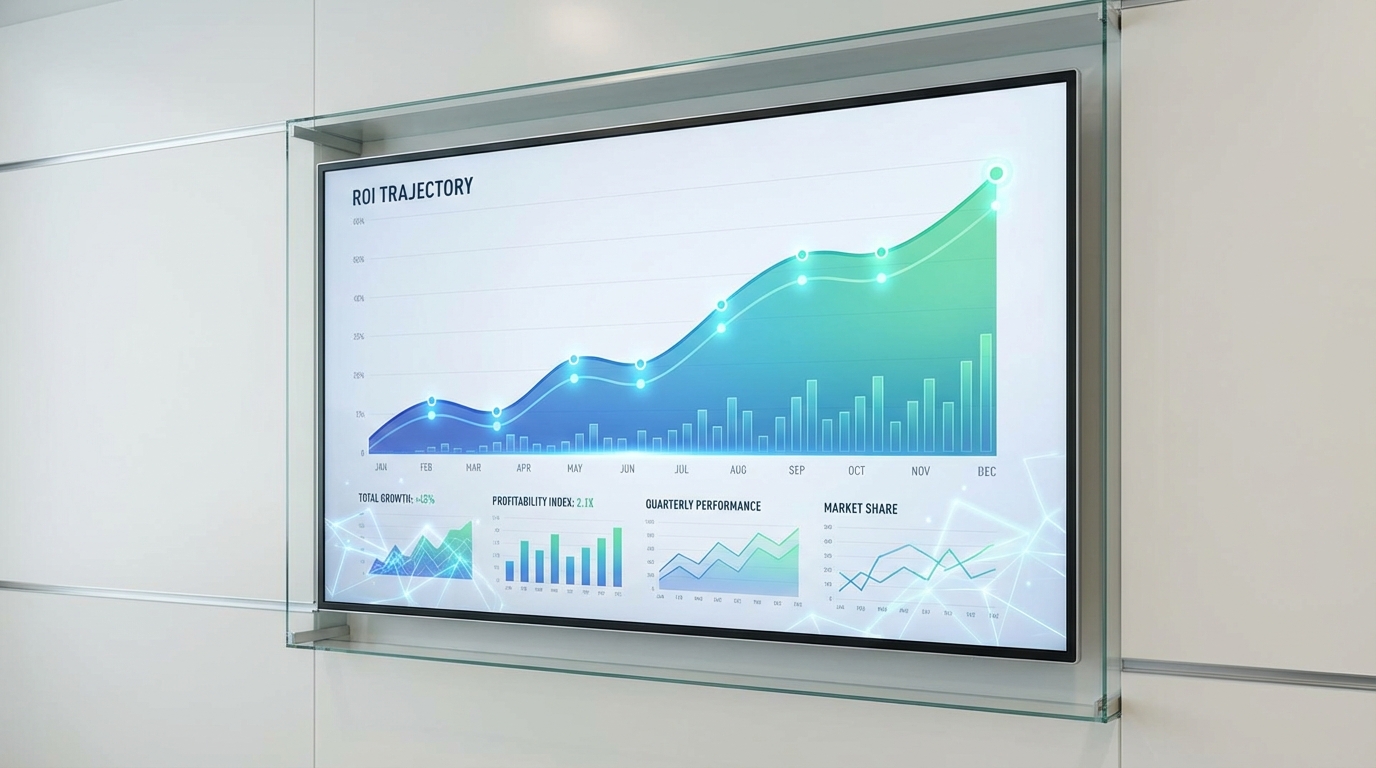
ROI Formula and Key Metrics
The fundamental ROI calculation for predictive maintenance follows this structure:
ROI = (Annual Benefits - Annual Costs) / Total Investment × 100%
However, accurately quantifying annual benefits requires examining multiple value streams:
Downtime prevention savings: This represents the largest ROI component for most solar operators. Calculate your baseline downtime costs by multiplying average daily revenue by annual downtime days, then apply the 30-50% reduction factor demonstrated by predictive maintenance systems.
Example calculation for a 100 MW portfolio:
- Average daily revenue: $30,000 (assuming $0.05/kWh and 6 peak sun hours)
- Baseline annual downtime: 15 days (3% downtime rate)
- Baseline downtime cost: $450,000 annually
- Predictive maintenance reduction: 40% (conservative mid-range estimate)
- Annual downtime savings: $180,000
Reduced emergency maintenance costs: Emergency repairs typically cost 2-3× planned maintenance rates due to expedited parts, overtime labor, and contractor premiums. Predictive maintenance converts 60-80% of emergency repairs to planned maintenance, generating significant savings.
Example calculation:
- Baseline emergency repairs: 12 incidents annually at $15,000 average cost = $180,000
- Predictive maintenance prevention: 70% converted to planned maintenance
- Planned maintenance cost for same repairs: $6,000 average
- Annual emergency repair savings: $75,600
Extended equipment lifespan: Preventing failures and addressing degradation early extends component life, deferring major capital replacements. For a 100 MW portfolio with $10 million in inverter and electrical equipment, extending lifespan by 20% defers $2 million in replacement costs over the equipment lifecycle—equivalent to $100,000-150,000 in annual value when amortized.
Improved energy production: Predictive maintenance keeps equipment operating at peak efficiency, preventing the gradual performance degradation that reduces output. Even a 1% improvement in annual energy production for a 100 MW portfolio represents $180,000 in additional revenue at typical energy prices.
Reduced grid penalties: For operators engaged in energy trading or subject to grid scheduling requirements, accurate solar forecasting integrated with predictive maintenance prevents forecast deviations caused by undetected equipment issues. Avoiding even 2-3 significant penalty events annually can save $50,000-100,000.
Complete ROI example for 100 MW portfolio:
Annual Benefits:
- Downtime prevention: $180,000
- Emergency repair reduction: $75,600
- Extended equipment life: $125,000
- Improved production: $180,000
- Reduced grid penalties: $75,000
- Total Annual Benefits: $635,600
Annual Costs:
- Platform subscription: $50,000
- Support and training: $10,000
- Data connectivity: $6,000
- Total Annual Costs: $66,000
Initial Investment:
- Platform setup: $30,000
- Integration: $25,000
- Training: $10,000
- Total Initial Investment: $65,000
First Year ROI: ($635,600 - $66,000 - $65,000) / $65,000 = 774%
Ongoing Annual ROI: ($635,600 - $66,000) / $66,000 = 863%
Payback Period: 65,000 / ($635,600 - $66,000) = 1.4 months
These calculations demonstrate why predictive maintenance delivers such compelling returns—the prevented downtime and avoided emergency repairs alone typically exceed total platform costs within the first quarter of operation. For larger portfolios (500+ MW), absolute savings scale proportionally while per-MW costs decrease, driving even more attractive ROI metrics.
Conservative operators should use the lower end of benefit ranges (30% downtime reduction, 60% emergency repair prevention) when building business cases, which still typically deliver 300-500% first-year ROI and 3-6 month payback periods.
5. Pricing Factors That Impact Your Predictive Maintenance Investment
Predictive maintenance costs vary significantly based on portfolio characteristics and operational requirements. Understanding these pricing factors helps solar asset owners estimate investment requirements accurately and identify opportunities for cost optimization.
Portfolio size and monitored capacity: This represents the primary pricing driver for most platforms. Subscription costs typically scale with total MW under management, but with volume discounts that reduce per-MW costs as portfolio size increases. A 50 MW portfolio might pay $250/MW annually ($12,500 total), while a 500 MW portfolio might pay $150/MW annually ($75,000 total) due to volume pricing. Operators managing distributed portfolios should clarify whether pricing is based on total capacity or number of individual sites, as some vendors charge per-location fees that can significantly impact costs for portfolios with many smaller installations.
Monitoring granularity and depth: Plant-level monitoring costs significantly less than component-level tracking. Basic systems that monitor overall plant performance and major equipment (inverters, transformers) typically cost 40-60% less than comprehensive platforms offering string-level monitoring with detailed component health scoring. However, the ROI calculation often favors deeper monitoring—string-level issues represent a major source of hidden production losses that plant-level systems miss entirely. Platforms offering multi-level monitoring from plant to string level with 74+ visualization types provide the granularity needed to identify issues early while they're still inexpensive to address.
Forecasting requirements: Solar operators requiring integrated energy forecasting for grid scheduling or trading applications should evaluate whether predictive maintenance platforms include forecasting capabilities or require separate solutions. Integrated platforms that combine predictive monitoring with accurate solar forecasting (98% accuracy with 15-minute to 14-day horizons) deliver better value than purchasing separate point solutions, while also ensuring forecast models account for equipment condition and predicted failures.
Alert management complexity: Basic monitoring systems generate simple threshold-based alerts that often create more noise than value. Advanced intelligent alert management with ML-based anomaly detection, severity classification (four levels from informational to critical), and automated escalation workflows costs more but dramatically improves operational efficiency. The cost difference is typically 20-30%, but the value in reduced alert fatigue and faster issue resolution often justifies the investment.
Integration requirements: Portfolios with complex existing technology stacks—multiple inverter brands, legacy SCADA systems, custom data historians—face higher integration costs than greenfield installations or standardized technology environments. Platforms offering flexible integration options including API access, standard protocols (Modbus, OPC), and multiple data delivery methods (dashboard, email, FTP/SFTP) reduce integration complexity and associated costs.
Geographic distribution: Portfolios distributed across multiple regions or countries may face additional costs for localized support, multi-language interfaces, or compliance with regional data sovereignty requirements. For operators managing assets across India—from Bengaluru to Ahmedabad to Mumbai—and expanding globally, platforms with proven international deployment experience and regional support capabilities provide better value despite potentially higher costs than domestic-only solutions.
Reporting and analytics requirements: Standard automated reporting typically covers operational metrics and performance summaries. Organizations requiring custom reports, ESG impact tracking, investor-grade documentation, or integration with business intelligence tools may incur additional costs for advanced analytics capabilities. However, comprehensive solar analytics platforms that include automated reporting with customizable templates often provide these capabilities within standard subscription pricing.
Scalability and future growth: Operators planning portfolio expansion should evaluate pricing structures for adding capacity. Some vendors charge full per-MW rates for additions, while others offer preferential pricing for capacity added to existing contracts. Understanding scalability costs upfront prevents budget surprises as portfolios grow.
6. Budget Planning Strategies for Solar Asset Owners
Strategic budget planning for predictive maintenance implementation can significantly impact both upfront investment requirements and long-term ROI. These proven strategies help solar asset owners structure investments for maximum financial efficiency.
Phased implementation approach: Rather than deploying predictive maintenance across an entire portfolio simultaneously, many operators implement in phases that spread costs over multiple budget cycles while proving ROI incrementally. A typical phased approach might begin with 20-30% of portfolio capacity in year one, expand to 60-70% in year two based on demonstrated results, and complete full deployment in year three. This strategy reduces initial investment by 60-70% while generating performance data that strengthens business cases for subsequent phases.
Pilot program strategy: Launching a focused pilot on 2-3 representative sites allows operators to validate platform capabilities, quantify actual ROI, and refine operational workflows before committing to full portfolio deployment. Effective pilots typically run 3-6 months and cost $15,000-40,000 depending on site size. The performance data generated during pilots provides concrete evidence for securing budget approval for broader implementation. When structuring pilots, select sites that represent diverse conditions in your portfolio—different equipment vintages, geographic locations, and operational challenges—to ensure results translate across your full asset base.
Portfolio prioritization framework: Not all solar assets deliver equal ROI from predictive maintenance. Prioritize implementation based on these factors:
- Highest revenue sites: Assets with premium power purchase agreements or favorable energy pricing deliver maximum downtime prevention value
- Aging equipment: Installations with equipment approaching end-of-warranty or showing elevated failure rates benefit most from early failure detection
- Remote locations: Sites where maintenance response times are longest and emergency repair costs highest see amplified ROI from failure prevention
- Grid-critical assets: Installations subject to grid scheduling penalties or supporting energy trading operations require the forecasting accuracy that predictive maintenance enables
Building the stakeholder business case: Securing budget approval requires translating technical capabilities into financial outcomes that resonate with decision-makers. Effective business cases include:
- Conservative ROI calculations using lower-bound benefit estimates (30% downtime reduction rather than 50%)
- Payback period analysis showing investment recovery timeline (typically 3-12 months)
- Risk mitigation value—quantifying avoided catastrophic failure scenarios
- Competitive positioning—how predictive maintenance supports strategic objectives like portfolio expansion or improved investor returns
- Vendor credibility—demonstrated track record with specific performance metrics (98% forecasting accuracy, 30-50% downtime prevention)
Budget allocation by portfolio size: These guidelines provide starting points for budget planning across different portfolio scales:
- Small portfolios (10-50 MW): Budget $25,000-60,000 for initial implementation and $15,000-35,000 annually for ongoing operations. Focus on platforms offering strong value at smaller scale without enterprise minimums.
- Mid-size portfolios (50-200 MW): Budget $60,000-150,000 for initial implementation and $35,000-100,000 annually. This scale typically achieves strong ROI across full portfolio deployment.
- Large portfolios (200-500 MW): Budget $150,000-300,000 for initial implementation and $100,000-250,000 annually. Volume pricing and economies of scale drive attractive per-MW costs.
- Enterprise portfolios (500+ MW): Budget $300,000-600,000+ for initial implementation and $250,000-500,000+ annually. Negotiate custom pricing structures and consider dedicated support resources.
Cost optimization strategies: These approaches reduce investment requirements without sacrificing performance:
- Leverage existing monitoring infrastructure—platforms that integrate with current systems reduce hardware investment
- Start with plant and inverter-level monitoring, adding string-level detail for problem sites rather than portfolio-wide
- Negotiate multi-year contracts for 10-20% annual cost reductions
- Bundle forecasting and monitoring requirements with single vendor for integrated pricing
- Utilize included training and support resources fully to minimize external consulting costs
Planning for scalability: Structure initial contracts with clear terms for adding capacity as portfolios grow. Negotiate preferential pricing for additions (typically 20-30% discount from standard rates) and ensure platform architecture supports seamless expansion without re-implementation costs.
7. What to Look for in a Predictive Maintenance Platform
Selecting the right predictive maintenance platform requires evaluating capabilities across multiple dimensions. These essential features and evaluation criteria help solar asset owners identify solutions that deliver maximum value.
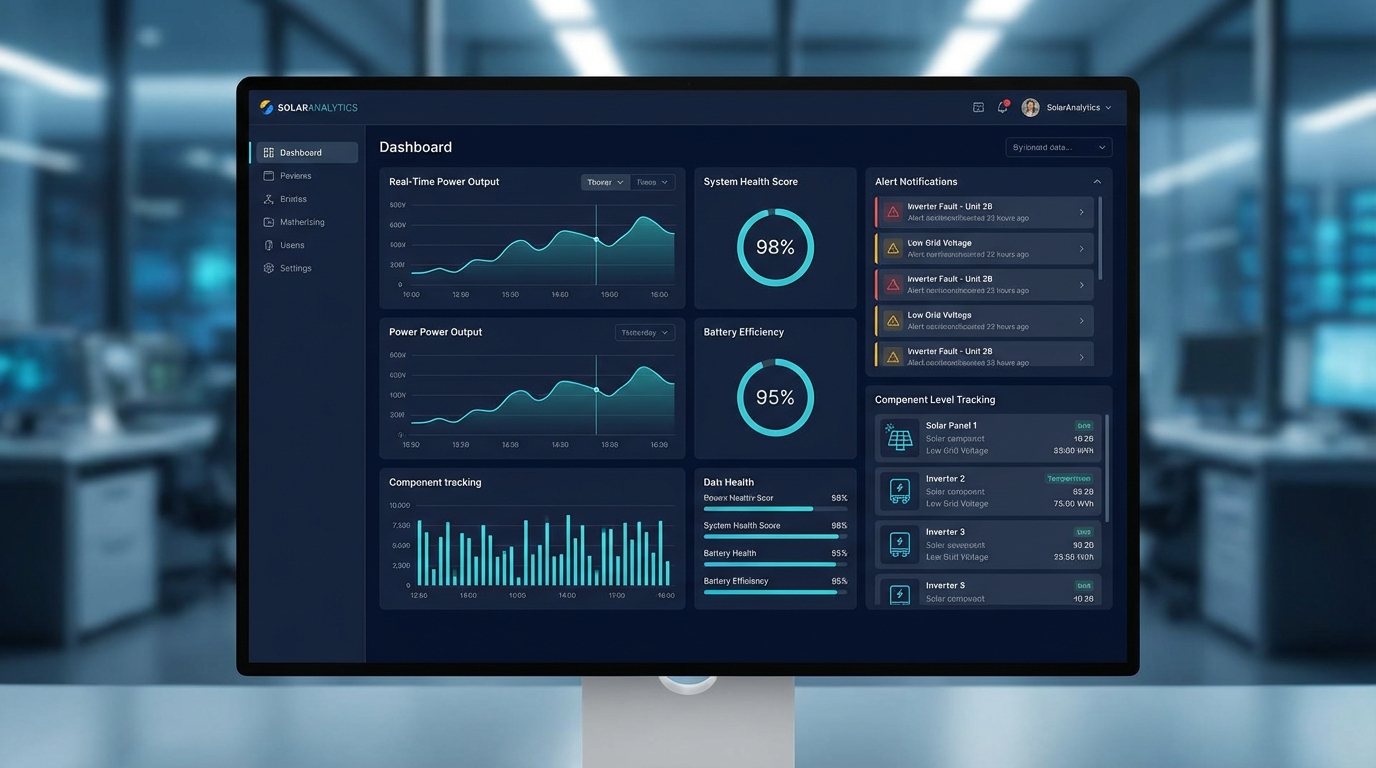
ML-based predictive capabilities: The core value of predictive maintenance comes from machine learning algorithms that identify failure patterns and degradation trends invisible to rule-based systems. Evaluate platforms based on:
- Demonstrated prediction accuracy with specific metrics (not vague "AI-powered" claims)
- Health scoring systems that quantify component condition (0-100% scales provide intuitive assessment)
- Failure prediction horizons—how far in advance the system identifies emerging issues (weeks to months is ideal)
- Algorithm transparency—understanding what factors drive predictions enables operational trust
Forecasting accuracy benchmarks: For operators requiring energy forecasting for grid scheduling or trading, accuracy is paramount. Leading platforms achieve 98% accuracy using advanced techniques like GraphCast and cloud motion vectors. Evaluate forecasting capabilities across multiple horizons:
- Intraday forecasting (15-minute to 6-hour horizons) for real-time grid scheduling
- Day-ahead forecasting (24-48 hours) for energy trading and maintenance planning
- Extended forecasting (7-14 days) for strategic planning and resource allocation
Request vendor performance data showing actual forecast accuracy across different weather conditions and seasons, not just optimal-case scenarios.
Multi-level monitoring depth: Comprehensive solar performance tracking requires visibility from plant level down to individual components. Essential monitoring capabilities include:
- Plant-level performance and energy production tracking
- Inverter monitoring with individual unit health assessment
- String combiner box (SCB) monitoring for electrical system visibility
- String-level tracking to identify underperforming arrays
- Environmental monitoring (irradiance, temperature, weather) for performance normalization
Platforms offering 74+ visualization types provide the flexibility to analyze data from multiple perspectives, identifying issues that single-view systems miss.
Intelligent alert management: Alert systems make or break operational efficiency. Poor alert design creates fatigue where operators ignore notifications, while intelligent systems focus attention on genuine issues. Look for:
- Severity classification (four levels from informational to critical) that enables appropriate response prioritization
- ML-based anomaly detection that distinguishes genuine issues from normal operational variations
- Configurable escalation workflows that route alerts to appropriate personnel
- Alert correlation that groups related notifications to prevent notification storms
- Real-time delivery via multiple channels (dashboard, email, SMS) based on severity
Component-level tracking: Detailed asset management requires tracking individual components throughout their lifecycle. Essential capabilities include:
- Inverter tracking with model, serial number, installation date, and maintenance history
- String combiner box monitoring with circuit-level detail
- String performance tracking with historical trending
- Maintenance event logging linked to specific components
- Warranty tracking and end-of-life planning
Integration flexibility: Platforms must work within existing technology ecosystems. Evaluate integration capabilities including:
- Support for major inverter brands and communication protocols (Modbus, OPC, proprietary APIs)
- SCADA system integration for unified operational visibility
- Data delivery options (dashboard, email, FTP/SFTP) for workflow flexibility
- API access for custom integrations and business intelligence tools
- Export capabilities for regulatory reporting and investor communications
Analytics and reporting: Comprehensive solar analytics transform raw monitoring data into actionable intelligence. Essential features include:
- Automated reporting with customizable templates and schedules
- Performance benchmarking against expected production and historical baselines
- Financial analytics linking performance to revenue impact
- ESG impact tracking for sustainability reporting (CO2 offset, renewable energy generation)
- Maintenance analytics showing intervention effectiveness and cost tracking
- Portfolio-level dashboards for multi-site operations
Scalability for portfolio growth: Platforms should accommodate portfolio expansion without architectural limitations or cost penalties. Verify:
- Maximum capacity limits (some platforms cap at specific MW thresholds)
- Multi-site management capabilities for distributed portfolios
- User access controls for organizations with multiple operational teams
- Performance at scale—response times and data processing speeds with large datasets
Vendor track record and support: Platform capabilities matter less if vendor support is inadequate. Evaluate:
- Deployment experience with portfolios similar to yours in size and complexity
- Customer references and case studies with specific performance metrics
- Support availability (24/7 for critical operations vs. business hours)
- Training programs and documentation quality
- Product roadmap and innovation commitment—platforms should evolve with technology
- Financial stability and long-term viability
For solar operators managing portfolios across diverse regions—from Bengaluru to Ahmedabad to Mumbai and beyond—verify that vendors have experience with geographic distribution, multi-region support capabilities, and understanding of local operational challenges.
8. Making the Investment Decision: Key Considerations for 2026
As solar operators evaluate predictive maintenance investments in 2026, several strategic considerations should guide decision-making beyond pure cost analysis.
Proof of concept importance: Given the significant performance claims made by predictive maintenance vendors—30-50% downtime reduction, 98% forecasting accuracy—operators should insist on proof before committing to full portfolio deployment. Effective proof of concept programs typically include:
- 3-6 month trial periods on representative sites
- Clearly defined success metrics agreed upfront (downtime reduction percentage, alert accuracy, forecast error rates)
- Side-by-side comparison with existing monitoring approaches
- Documented cost savings and ROI calculation
- Operational workflow validation with actual maintenance teams
Vendors confident in their capabilities should readily agree to performance-based proof of concept programs. Reluctance to provide trials or vague success criteria are red flags.
Contract terms and pricing transparency: Predictive maintenance represents a multi-year operational commitment. Negotiate contract terms that protect your interests:
- Clear pricing structures with no hidden fees for standard features
- Defined terms for adding capacity as portfolios grow
- Performance guarantees with remedies if platforms underdeliver
- Data ownership and portability provisions ensuring you can access your data if switching vendors
- Reasonable termination clauses that don't lock you into underperforming solutions
- Annual price increase caps (typically 3-5% maximum)
Support and training offerings: Platform capabilities mean little if your team can't use them effectively. Evaluate vendor support programs:
- Onboarding programs that train operations teams on predictive maintenance workflows
- Ongoing training as platforms add features and capabilities
- Technical support responsiveness—response time commitments for different issue severities
- Dedicated account management for enterprise deployments
- User communities and knowledge bases for peer learning
Platform innovation and roadmap: Predictive maintenance technology evolves rapidly. Vendors should demonstrate commitment to continuous improvement:
- Regular platform updates and feature releases (quarterly or more frequent)
- Investment in ML algorithm refinement and accuracy improvement
- Roadmap transparency showing planned capabilities
- Customer input processes that shape product development
- Integration with emerging technologies (advanced weather forecasting, satellite monitoring, etc.)
Platforms like HelioExpect's Predictive Monitoring that combine ML-based predictive maintenance with 0-100% health scoring and component-level tracking represent the current state-of-the-art, but should continue evolving to maintain competitive advantage.
Data security and compliance: Solar operations data contains sensitive information about asset performance, locations, and operational patterns. Verify platforms provide:
- Enterprise-grade data encryption (in transit and at rest)
- Compliance with relevant standards (SOC 2, ISO 27001, etc.)
- Data residency options for regions with sovereignty requirements
- Access controls and audit logging
- Regular security assessments and penetration testing
Integration with forecasting capabilities: Operators requiring both predictive maintenance and solar forecasting should strongly consider integrated platforms that combine both capabilities. Separate point solutions create data silos and miss the synergies between equipment condition and production forecasting. When equipment degradation or failures are predicted, forecasting models should automatically adjust production predictions—integration that separate systems can't achieve. Platforms offering comprehensive solar forecasting with 98% accuracy alongside predictive monitoring deliver superior value through this integration.
Questions to ask potential vendors:
- What is your demonstrated downtime reduction percentage across your customer base? (Request specific data, not marketing claims)
- What is your forecasting accuracy across different weather conditions and seasons?
- How many solar portfolios similar to ours (size, geography, equipment) do you currently monitor?
- What is your average customer retention rate and why do customers leave?
- Can you provide references from customers managing portfolios in our target regions?
- What is your typical implementation timeline and what resources do we need to provide?
- How do you handle platform updates—are they automatic or do they require downtime?
- What happens to our data if we terminate the contract?
- How do your ML algorithms improve over time and do we benefit from improvements automatically?
- What is your product roadmap for the next 12-24 months?
Vendors who provide transparent, data-backed answers to these questions demonstrate the credibility and operational maturity that long-term partnerships require.
Frequently Asked Questions About Predictive Maintenance Costs
What is the average cost of predictive maintenance for solar portfolios?
Predictive maintenance costs vary significantly based on portfolio size and monitoring depth. For mid-sized portfolios (50-200 MW), expect annual subscription costs of $35,000-100,000 with initial implementation investments of $60,000-150,000. Per-MW costs typically range from $150-500 annually depending on features, with volume discounts for larger portfolios. The key metric is ROI rather than absolute cost—most implementations deliver 300-800% first-year returns through downtime prevention and avoided emergency repairs.
How long does it take to see ROI from predictive maintenance?
Most solar operators see positive ROI within 3-6 months of implementation. The prevented downtime from even a single major failure event often exceeds annual platform costs. First-year ROI typically ranges from 300-800% depending on portfolio size and baseline downtime rates. Conservative implementations targeting 30% downtime reduction still achieve payback within 6-12 months, while portfolios with higher baseline failure rates see even faster returns.
Can predictive maintenance platforms integrate with existing monitoring systems?
Yes, modern predictive maintenance platforms are designed to integrate with existing SCADA systems, inverter monitoring tools, and data historians. Integration complexity varies based on your current technology stack—standardized systems using common protocols (Modbus, OPC) integrate easily, while legacy custom systems may require additional implementation work. Platforms offering flexible data delivery methods including API access, FTP/SFTP, and standard protocols minimize integration challenges. Budget $15,000-50,000 for integration depending on complexity.
What's the difference between monitoring and predictive maintenance?
Traditional solar monitoring tracks current performance and generates alerts when parameters exceed thresholds—it's reactive, responding to problems after they occur. Predictive maintenance uses machine learning to analyze performance patterns and forecast failures before they happen—it's proactive, enabling planned interventions that prevent downtime. Predictive systems include monitoring capabilities but add ML-based health scoring, failure prediction, and intelligent alerting that distinguishes genuine issues from normal variations. The cost difference is typically 30-50% higher for predictive capabilities, but the ROI from prevented downtime far exceeds the incremental investment.
Is predictive maintenance worth it for smaller solar portfolios?
Yes, though the absolute dollar savings scale with portfolio size. A 20 MW portfolio preventing 40% of baseline downtime (saving $80,000-120,000 annually) achieves strong ROI on $20,000-35,000 in annual platform costs. Smaller operators should focus on platforms without enterprise minimums and prioritize core predictive capabilities over advanced features. The key is that downtime costs scale with portfolio size, so percentage-based ROI remains attractive even at smaller scales. Portfolios below 10 MW should carefully evaluate whether their baseline downtime justifies predictive maintenance investment or whether basic monitoring suffices.
How does predictive maintenance pricing scale with portfolio size?
Pricing typically follows a per-MW model with volume discounts. Small portfolios (10-50 MW) might pay $200-300/MW annually, mid-size portfolios (50-200 MW) pay $150-250/MW, and large portfolios (500+ MW) negotiate $100-200/MW or custom enterprise pricing. Initial implementation costs also scale with portfolio size but at lower rates—doubling portfolio size might increase implementation costs by 50-70% rather than 100%. This scaling means larger portfolios achieve better per-MW economics while smaller portfolios still achieve strong ROI through downtime prevention.
Conclusion: Making the Strategic Investment in Predictive Maintenance
The economics of predictive maintenance for solar assets are compelling: implementations typically deliver 300-800% first-year ROI through prevented downtime, avoided emergency repairs, and extended equipment lifespan. For solar operators managing portfolios from 50 MW to 500+ MW across diverse regions—whether concentrated in Bengaluru, distributed across Ahmedabad and Mumbai, or spanning global markets—predictive maintenance has evolved from optional technology to operational necessity.
The cost structure is straightforward: initial investments of $25,000-150,000 depending on portfolio size, annual subscription costs of $150-500 per MW, and ongoing operational expenses that are more than offset by operational savings. The critical success factor is selecting platforms that deliver genuine predictive capabilities—ML-based health scoring, component-level tracking, intelligent alert management, and demonstrated performance metrics like 98% forecasting accuracy and 30-50% downtime reduction.
As you evaluate predictive maintenance investments for your solar portfolio, focus on these strategic priorities:
- Start with clear ROI calculations based on your actual downtime costs and maintenance expenses—conservative estimates still typically show 6-12 month payback periods
- Insist on proof of concept programs that validate vendor claims with your specific assets before committing to full deployment
- Prioritize platforms offering integrated capabilities—combining predictive monitoring with accurate solar forecasting delivers superior value to separate point solutions
- Evaluate total cost of ownership including implementation, training, and ongoing operations rather than focusing solely on subscription fees
- Plan for scalability with contract terms that accommodate portfolio growth at preferential pricing
The solar industry in 2026 has reached a maturity point where data-driven operations separate high-performing portfolios from underperforming assets. Predictive maintenance provides the operational intelligence that maximizes solar ROI, prevents costly failures, and enables the proactive asset management that today's competitive energy markets demand.
For solar asset owners ready to move beyond reactive maintenance approaches, platforms like HelioExpect's Predictive Monitoring offer the proven capabilities—ML-based predictive maintenance, 0-100% health scoring, multi-level monitoring, and intelligent alerting—that deliver measurable downtime reduction and operational savings. Combined with industry-leading solar forecasting achieving 98% accuracy, integrated platforms provide the comprehensive solar intelligence that maximizes portfolio performance.
The question facing solar operators is no longer whether to invest in predictive maintenance, but how quickly you can implement solutions that prevent the 30-50% of downtime that's costing your operation hundreds of thousands or millions annually. Contact HelioExpect to discuss how predictive maintenance can transform your solar operations and deliver measurable ROI for your specific portfolio characteristics.